
Horizontal Vacuum Belt Filters (HBVF) Practical Guide: How They Work, Optimal Conditions, and When to Choose a Filter Press
A Horizontal Vacuum Belt Filter (HBVF) is a horizontal-belt filtration system engineered for continuous operation, allowing plants to dewater and wash massive volumes of slurry. While widely deployed in high-throughput applications like flue gas desulfurization (FGD) gypsum, mineral concentrates, and phosphoric acid production, filter presses still hold the upper hand in processes that require strict moisture control or aggressive corrosion resistance. This guide breaks down how HBVFs work, highlights the best operating conditions, and provides a clear selection framework by comparing them directly with filter presses.
1. What is a Vacuum Belt Filter? Basics of Continuous Solid-Liquid Separation
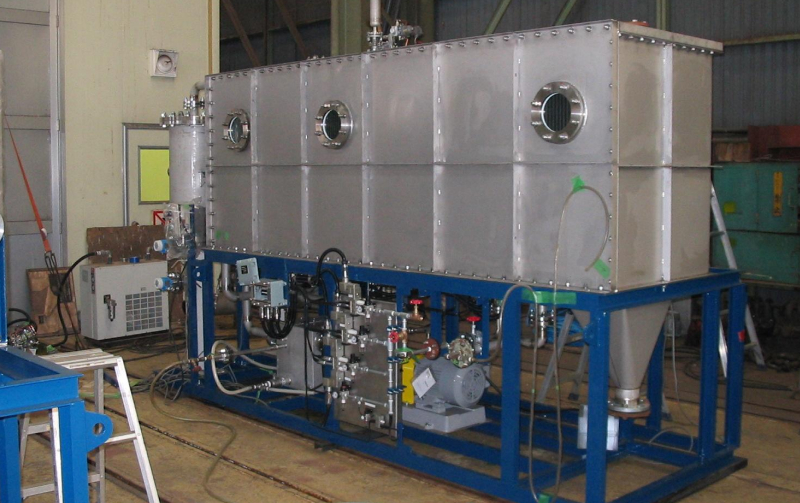
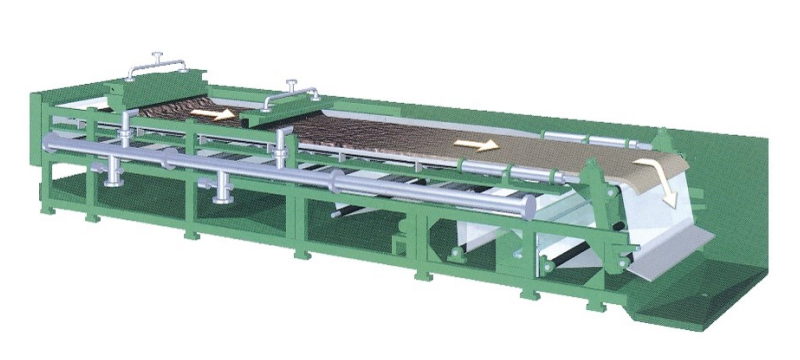
An HBVF functions as a complete continuous process, handling everything from initial slurry feeding to final cake discharge on a horizontally moving belt. Utilizing vacuum (suction) as its primary driving force, it stands alongside rotary vacuum filters and filter presses as one of the core methods of solid-liquid separation.
1.1 Definition and Classification
Solid-liquid separation systems are generally categorized by their operation type (continuous vs. batch) and driving force (vacuum, pressure, or gravity). Within this framework, the HBVF is classified as a continuous, vacuum-driven system. Filtration, washing, and dewatering progress steadily as the slurry travels down the horizontally arranged belt. While it shares the same vacuum drive as rotary vacuum filters (drum or disc types), its horizontal layout offers unique advantages: operators can easily monitor the cake visually, and plants can easily set up multiple multistage washing zones in a straight line.
1.2 Key Components and Materials
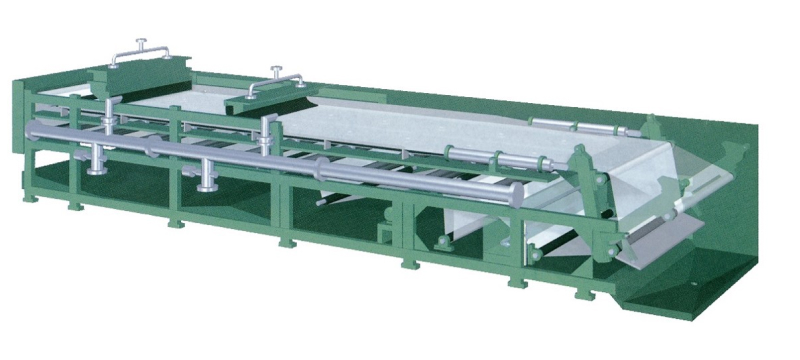
The primary components of an HBVF include the rubber drainage belt (a conveyor belt equipped with drainage holes), filter cloth, vacuum box, feed box, washing unit, discharge section, cloth-washing spray bar, and belt tensioning and tracking assemblies. The rubber drainage belt is the most expensive consumable component. Its material is carefully selected from options like natural rubber, SBR, or EPDM, depending on the corrosiveness and temperature of the process fluid. Selecting the right materials for all wetted parts directly impacts both equipment lifespan and operational stability.
2. Operating Principle: The Continuous Loop from Feed to Cake Discharge
The HBVF runs on a continuous loop through a sequence of steps:
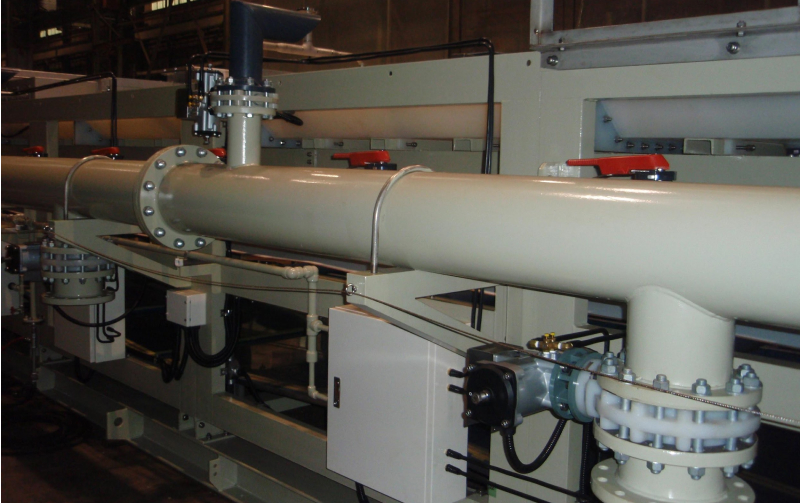
Slurry Feed → Cake Formation → Cake Washing → Dewatering → Discharge → Cloth Washing. Designed with partitioned zones, the system isolates the primary cake filtrate from the washing filtrate for independent recovery.
Three main control variables dictate your product quality: belt speed, vacuum pressure, and cake thickness.
2.1 Slurry Feed and Cake Formation Zone
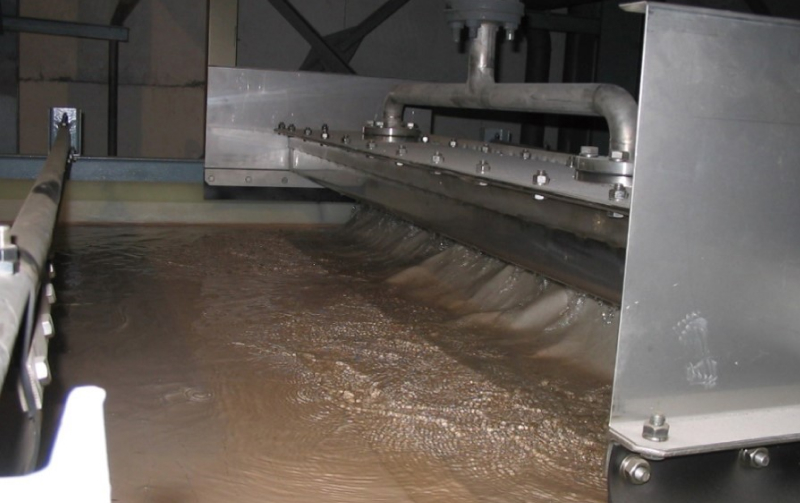
The feed box distributes the slurry uniformly across the full width of the belt to ensure an even cake forms on the filter cloth. In fast-settling slurries, coarser particles deposit first to form a natural precoat layer. This layer efficiently captures finer particles, which increases overall filtrate clarity. Cake thickness generally ranges between 5 mm and 150 mm, and is actively managed by adjusting the belt speed and incoming feed volume.
2.2 Cake Washing Zone (Multistage Countercurrent Washing)
The washing zone is frequently designed with a multistage countercurrent configuration. By recycling downstream wash filtrate back to the upstream stages, the system minimizes the consumption of fresh wash water while maximizing both impurity removal and product recovery rates. Two to four stages are standard. Uniform washing relies entirely on an even cake formation; if the cake thickness varies, the wash liquid will bypass the thicker sections and short-circuit through the thinner spots (channelling), severely reducing washing efficiency.
2.3 Dewatering Zone and Cake Discharge
After the washing stage, continuous vacuum suction pulls residual moisture out of the cake to lower its overall water content. The vacuum level on an HBVF typically tops out between 0.04 and 0.07 MPa, with achievable cake moisture levels generally falling around 10% to 25% in practical operations, depending on slurry characteristics. At the end of the belt, the cake discharges via gravity or a mechanical scraper, and the filter cloth is instantly washed by a spray bar to prepare for the next cycle.
3. Optimal Conditions and Typical Applications for Vacuum Belt Filters
HBVFs perform best in continuous, high-volume processes where the slurry has a fast settling rate and requires multistage washing. Conversely, their limitations become apparent with ultra-fine slurries or applications demanding extremely low cake moisture levels.
3.1 Continuous, High-Volume Processing of Coarse, Fast-Settling Slurries
Due to HBVF's horizontal layout, gravity and fluid weight directly assist the filtration process. Materials with fast settling rates or large particle sizes form a cake on the belt almost instantly, resulting in exceptionally high filtration efficiency. Available filtration areas range widely—from small 0.1m² pilot units to massive large-scale systems exceeding 200m²—making them an ideal fit for large-scale, continuous processing.
3.2 Typical Applications: FGD Gypsum, Mining, and Phosphoric Acid
In FGD (Flue Gas Desulfurization) gypsum dewatering, a two-unit setup (one operating, one standby) is standard practice, continuously transforming slurry with roughly 45% solids content into a cake with under 10% moisture. In the mining sector, HBVFs are widely adopted for dewatering mineral concentrates—such as iron ore, lithium, copper, and uranium—as well as for tailings processing. In phosphoric acid lines, maximizing P₂O₅ recovery is critical, making the HBVF a top choice due to its ability to easily integrate inline, multistage washing zones.
3.3 Non-Optimal Process Conditions: Fine Particulates, High Adhesion, and High Corrosion Risks
HBVF performance deteriorates when processing slow-settling suspensions or fine particle slurries prone to causing filter media blinding. Due to its vacuum-induced differential pressure mechanism, the system exhibits inherent limitations regarding minimum achievable cake moisture, rendering it less capable of matching the performance of high-pressure filter presses. For highly adhesive or sticky cakes, cake release at the discharge terminal becomes inconsistent, which can escalate manual labor overhead and impair equipment availability metrics. Furthermore, structural configurations limit advanced corrosion-resistant engineering, making careful material selection essential for acidic or chloride-containing slurries.
For Fine Particles, Sticky Cakes, and Corrosive Slurries
When handling fine-particle slurries, highly adhesive filter cakes, or applications requiring superior corrosion resistance, a pressure filter press can be a better alternative to a vacuum belt filter. To determine the most suitable filtration method for your process, we recommend reviewing our product information and consulting with our engineering specialists
■ Product Catalog:
Learn about filter press designs, key features, and typical application examples.
■ Technical Consultation:
Consult with our experts to determine which filtration system is best suited for your slurry.
4. Vacuum Belt Filter vs. Filter Press: A System-Level Comparison
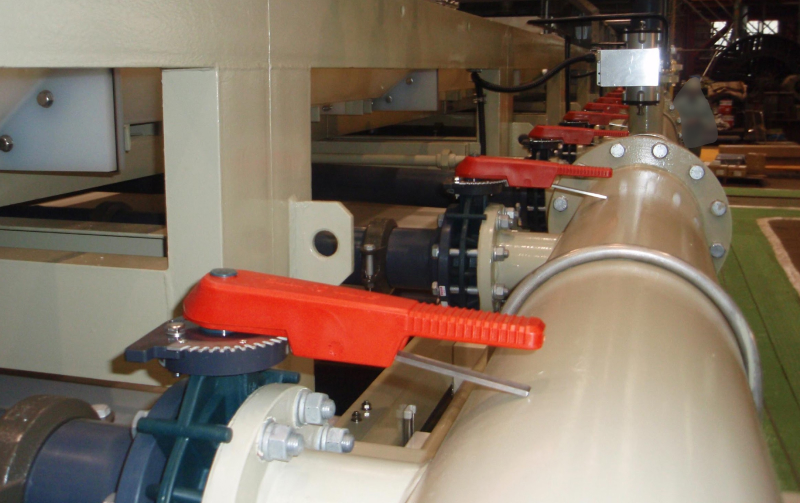
HBVFs and filter presses have fundamentally different characteristics when it comes to operation modes, driving forces, ultimate performance, maintenance requirements, and installation footprints. Here, we break down the four primary comparison axes that have the greatest impact on equipment selection. (Note: For a detailed breakdown of the structure and principles behind various filter press configurations, please refer to our dedicated article.)
4.1 Continuous vs. Batch Processing: Throughput vs. Cycle Time
HBVF operates continuously without stopping from feeding to discharge, making it ideal for high-volume, stable processing. In contrast, a filter press operates on a batch basis, repeating a cycle of clamping, feeding, filtration, squeezing, discharge, and cloth washing. The high driving force applied during the squeezing stage allows for tighter control to achieve lower moisture content. As a result, HBVF units tend to be advantageous in processes with extremely high filterability where throughput is the dominant factor, whereas filter presses are preferred when moisture content control is the dominant factor.
4.2 Cake Moisture and Driving Pressure (Vacuum vs. High Pressure)
The driving force of an HBVF is vacuum suction (0.04〜0.07MPa), yielding a final cake moisture level of roughly 10% to 25%. In contrast, a membrane filter press can apply high squeeze pressures ranging from 0.7 to 2.0 MPa, which can drastically reduce moisture content depending on the material. In applications where residual moisture directly dictates waste disposal costs—for example, dropping cake moisture from 85% to 70% cuts the total disposal weight in half—the return on investment (ROI) for a filter press becomes highly favorable. (Note: For a step-by-step ROI and Total Cost of Ownership (TCO) calculation framework, please refer to our dedicated article on filtration economics.)
4.3 Washing Uniformity, Corrosion Resistance, and Discharge Reliability
Washing Uniformity: While the HBVF excels at multistage countercurrent washing along its linear belt, its performance depends entirely on a perfectly even cake formation. Conversely, certain filter press models utilize specialized designs (such as a double top corner feed) to ensure homogeneous cake formation and thorough washing inside the chambers, making them the superior choice when wash consistency directly impacts product quality.
Corrosion Resistance: Filter presses can be engineered with completely non-metallic wetted parts, offering a major advantage in processes where aggressive corrosion or metal contamination must be avoided.
Discharge Reliability: Sticky cakes can cause unstable release at the discharge tip of an HBVF belt. Under these sticky conditions, filter presses equipped with mechanical cake scrapers hold a clear operational advantage.
4.4 Footprint, Costs (CAPEX/OPEX), and Maintenance
Footprint: The HBVF requires a massive horizontal space (the belt track can run dozens of meters long). The filter press uses a vertical plate stack, keeping the installation footprint relatively small.
CAPEX & OPEX: HBVFs generally offer lower upfront CAPEX. However, the rubber drainage belt is a high-cost consumable with long lead times, which adds to your ongoing OPEX.
Maintenance: A filter press centers its maintenance around cloth changeouts. Selecting a model designed for easy cloth changes can drastically reduce maintenance downtime.
5. Summary Table: Visual Selection Guide
The qualitative comparisons discussed above are summarized below based on practical selection criteria. Please note that these evaluations represent relative tendencies and may vary depending on slurry characteristics, target performance, and operational conditions.
| Comparison Factor | Vacuum Belt Filter | Filter Press |
|---|---|---|
| Operation Type | Continuous | Batch |
| Achievable Moisture Content | Approx. 10–25% | Adjustable to low moisture content |
| Washing Uniformity | On-belt multi-stage countercurrent (Requires uniform cake formation) | Uniform distribution achievable via feed design (depends on model) |
| Corrosion-Resistant Design | Alternative material options available | Metal-free wetted parts design available |
| Discharge Stability | Continuous discharge at belt edge (Sticky cakes pose a challenge) | Handles sticky cakes via scraper system |
| Installation Footprint | Large (Horizontal layout) | Small (Vertical stacking) |
| CAPEX / OPEX | Lower CAPEX. Belt replacement impacts OPEX. | Mainly cloth replacement; easy-maintenance designs available |
Based on this comparison, HBVF is best suited for processes where throughput is the top priority, while filter presses tend to be more adaptable for applications where moisture content control, washing uniformity, corrosion resistance, and discharge stability are critical.
6. Application Selection Guide: Which System Should You Choose?
Based on the comparison above, the selection criteria are as follows: HBVF is the top candidate when continuous high-volume processing is the highest priority and cake moisture content requirements are lenient. On the other hand, a filter press is the primary choice for corrosive slurries, high-purity washing, sticky cakes, and small-to-medium-scale batch operations.
Below, we outline the information that needs to be organized during the selection process, followed by the specific data required for the RFP.
6.1 Selection Checklist (Organizing Input Information)
To ensure the correct equipment selection, it is crucial to first organize the baseline slurry conditions and target performance metrics. Compiling a comprehensive list of slurry characteristics (pH, chloride concentration, temperature, particle size distribution, settling characteristics, and stickiness), target performance (throughput, target moisture content, and washing requirements/objectives: purity vs. recovery rate), and operational conditions (continuous vs. batch, number of shifts, installation footprint, and maintenance capabilities) will streamline the manufacturer comparison process.
6.2 Minimum Requirements for the RFP
When issuing a Request for Proposal (RFP) to manufacturers, providing a minimum baseline dataset is essential to ensuring accurate proposals. The primary items include throughput, solids concentration, particle size distribution, settling characteristics, pH/chloride concentration/temperature, target moisture content, washing requirements (whether for purity or recovery purposes), and installation footprint constraints. Especially for untested slurries, sizing based on filtration test results is the most reliable method to mitigate the risks of both over-sizing and under-sizing.
Make the Decision Based on Actual Data
The conclusion depends on which factor is most critical: throughput capacity, final cake moisture content, washability, corrosion resistance, solids discharge characteristics, or maintenance requirements. If a filter press remains a viable option, the fastest way to evaluate its suitability is to test it with your actual slurry.
■ Confirm suitability through a filtration test:
Measure actual performance, including cake discharge characteristics, washing efficiency, and corrosion resistance, and use the results to determine the appropriate filtration technology and equipment specifications.
7. Common Pitfalls: Uneven Washing, Corrosion, and Discharge Failure
The operational challenges that frequently arise on-site after equipment selection can be summarized into three pitfalls: quality variation due to uneven washing, leaks and metal contamination caused by corrosion, and the discharge failure of sticky cakes. The design philosophy of Kanadevia's filter presses, which will be discussed in the next chapter, is specifically engineered to address these issues.
7.1 Impact of Washing Uniformity on Quality and Recovery Rate
If cake formation is non-uniform, the washing liquid short-circuits through the thinner sections of the cake, leaving the thicker sections insufficiently washed. This results in inconsistent purity and lower recovery rates. In HBVF units, uniform slurry distribution dictates cake uniformity. In contrast, filter presses achieve uniformity through the internal feed structure of the filtration chambers (e.g., a double top corner feed). Uneven washing leads to re-washing and off-spec products, ultimately driving up operational costs.
7.2 Material Selection for Corrosive Slurries and Avoiding Metal Contamination
In processes involving acidic slurries or chlorides, the materials used for wetted parts directly dictate equipment lifespan and quality risks. When designs utilize metal for wetted parts, careful attention must be paid not only to leaks and repairs caused by corrosion, but also to metal contamination—which poses a risk to product quality and can cause catalyst poisoning in downstream processes. Filter presses offer designs where wetted parts can be made completely non-metallic, making them a preferred choice for processes where metal contamination must be strictly avoided.
7.3 Sticky Cake Discharge Failure and Reduced Uptime
Sticky cakes tend to cause unstable peeling at the belt edge, leading to cake residue, increased manual labor, and line stoppages. While HBVF units address this by running thin cakes or using auxiliary scrapers, there are physical limits if the cake is highly adhesive. Filter presses offer designs equipped with mechanical scraper systems that ensure stable cake discharge, providing a clear advantage in terms of both operational uptime and safety under highly sticky conditions.
8. Advantages of Filter Presses and Kanadevia’s Strengths
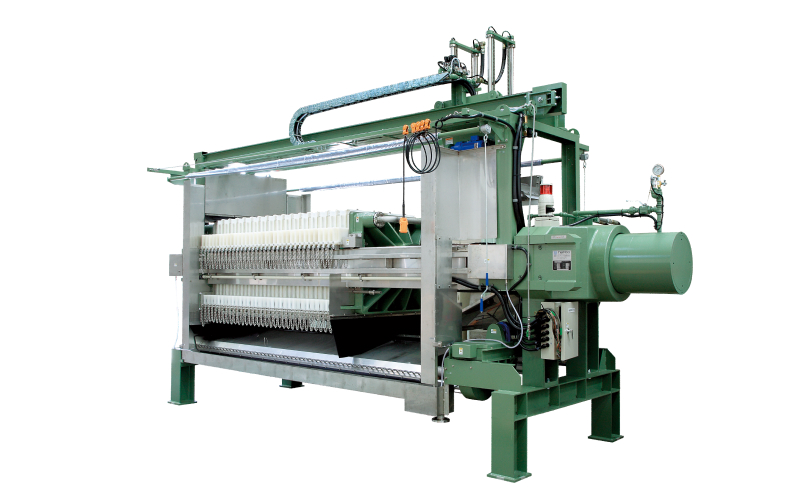
Filter presses are structurally advantageous in processes where corrosive slurries, high-purity washing, sticky cakes, and reduced maintenance labor are critical. Kanadevia’s filter presses incorporate a design philosophy that addresses these specific challenges through four core strengths.
8.1 Corrosive Slurries: Metal-Free Wetted Parts (PP + Rubber Materials) Design
In corrosive slurry applications, metallic components in wetted parts can cause corrosion, leaks, and metal contamination. Kanadevia’s filter presses utilize a design that completely eliminates metal from all wetted surfaces—employing a combination of polypropylene (PP), natural rubber (NR), and EPDM. This effectively prevents corrosion-induced leaks in acidic or chloride-bearing slurries and mitigates the risk of metal contamination that could impact downstream processes. Filtration testing is highly effective for verifying material compatibility.
8.2 Uniform Washing: Benefits of the Double Top Corner Feed
The double top corner feed structure uniformly distributes slurry into the filtration chambers, creating a symmetrical flow toward the diagonally opposite corners to minimize uneven cake dewatering. A uniform cake enables consistent washing, suppressing purity variations and recovery rate drops caused by the channeling of the washing liquid. This structure also helps prevent dripping, serving as a key design strength in processes where washing efficiency is a critical KPI.
8.3 Reliable Discharge: Scraper System and Ease of Maintenance
Equipped with a mechanical scraper system, our design ensures stable cake discharge even for sticky materials, reducing the manual labor burden and mitigating the risk of reduced uptime. The filter cloths feature a top-draped, secure-fit design that makes replacement straightforward, thereby minimizing maintenance downtime. For automation, users can select from manual, semi-automatic, automatic, or fully automatic levels. For small-to-medium-scale applications, the AUTOPAC(PRO) package unit is also available (regulatory compliance status for North American specifications requires separate verification). Slurry compatibility, including discharge performance, can be verified through filtration testing at our in-house testing facility, which features four single-chamber, 350 mm units (filtration area: 0.117 m²; chamber thicknesses: 25, 30, and 40 mm; witnessed testing available). Furthermore, a detailed comparison of each automation level is covered in our explanatory article on automatic filter presses.
9. Next Step: Consult with Kanadevia
The choice between an HBVF and a filter press depends on which factors are dominant: throughput, moisture content, washing, corrosion resistance, cake discharge, or maintenance. If your application aligns with the advantages of a filter press, conducting a filtration test for any new slurry is the most efficient way to finalize equipment specifications. When making an inquiry, providing the following information will help us deliver a highly tailored and specific proposal.
- Application / Intended Use
- Solids Concentration
- Slurry / Process Fluid Name
- Required Filtration Area
- Chamber Thickness
- pH, Chloride Concentration, and Temperature
- Target Moisture Content
- Washing Requirement (Purpose: Purity or Recovery)
Next Step
■ Request a Filtration Test / Technical Consultation
Compatibility Verification and Specification Review via Actual Slurry Testing.
■ Request a Quote
Obtain a commercial proposal for projects with established technical specifications.
■ Download Technical Literature
Access helpful resources for early-stage planning.