
FULLY AUTOMATIC FILTER PRESS: MODEL TFAP
Kanadevia’s TFAP model is a fully automatic filter press that automates the entire sequence from filtration, diaphragm squeezing, cake washing, plate opening, plate shifting, cake discharge, to filter cloth washing.
TFAP is designed with a strong focus on operational reproducibility and ease of maintenance. Key features include our unique “double top corner feed” plate design that enables uniform washing, non-metallic wetted-parts design for excellent chemical resistance, stable cake discharge using air-driven scrapers, and easy replacement of filter cloths and diaphragm sheets.
HOW TFAP SOLVES YOUR TROUBLES
- Eliminate Uneven Cake Washing: Our design prevents channeling to stabilize product purity and recovery.
- Withstand Harsh Environments: Features a metal-free design that meets strict chemical resistance requirements for acidic or alkaline slurries.
- Automate Sticky Cake Discharge: Specialized scrapers remove adhesive cakes without the need for manual labor.
- Reduce Maintenance Downtime:Easy-to-replace filter cloths and simplified maintenance procedures significantly reduce machine downtime.
- Prevent Metal Contamination: Optional gate-type scrapers lowers contamination risks for applications where the cake is the final product.
Note: Performance may vary depending on slurry characteristics, operating conditions, and auxiliary equipment configurations.
WHAT YOU WILL LEARN ON THIS PAGE
- Fundamentals of automatic filter presses and key points to consider for implementation
- Key features of the TFAP
- General structure, operating cycle, and touch panel functions of TFAP
- How to proceed with a filtration test
1. WHAT IS A FULLY AUTOMATIC FILTER PRESS?
A filter press is a batch type liquid-solid separation device that pumps slurry (liquid containing solids) through filter cloths to collect solids as “cake” while discharging the liquid as “filtrate”. As filtration progresses, a cake layer forms and contributes to capturing fine particles that are difficult to separate by filter cloth alone.
Automatic filter presses achieve a high level of automation by synchronizing key functional components: hydraulic cylinders for plate clamping, scrapers for automated cake discharge, drip trays for filtrate collection, and shifting blocks for plate separation.
2. BENEFITS OF A FULLY AUTOMATIC FILTER PRESS
Automation contributes not only to “labor savings” but also directly to improved operational reproducibility, safety, and product quality. Here, the general benefits are organized in relation to common on-site challenges:
- Reduced Workload: Automates repetitive tasks such as plate opening, cake discharge, and washing.
- Improved Safety: Automates the handling of high-pressure systems and heavy filter plates. Reduces the risk of mechanical hazards such as crushing or entrapment, as well as chemical splashes.
- Stable Quality: Allows filtration, squeezing, and washing conditions to be saved as recipes, reducing variations between cycles.
- Reduced Downtime: Stabilized cake discharge and cloth washing minimize manual intervention and setup/changeover time.
- Enhanced Traceability: Automates the tracking of operation conditions and status, making data recording and analysis more accessible and efficient.
3. FEATURES OF THE KANADEVIA’S FULLY AUTOMATIC FILTER PRESS - TFAP
TFAP is a fully automatic squeeze filter press designed for high dewatering performance, excellent cake washing, and stable cake discharge. It is widely used in applications ranging from manufacturing processes to environmental fields such as wastewater treatment.
3.1 4 KEY FEATURES
1. Uniform Dewatering & Washing: Double Top-Corner Feed
- Optimized Cake Formation: By positioning the feed inlets outside the filtration area, the system ensures highly uniform cake formation and washing efficiency.
- Minimized Short-Circuiting or Channeling: Wash water is supplied from the backside of the filter plates, preventing "short-circuiting" (bypass) and enabling thorough, consistent washing throughout the chamber.
2. Chemical & Corrosion Resistance: Metal-Free Wetted Parts
- Advanced Material Design: The wetted parts are designed without metal components to ensure superior chemical resistance.
- Material Selection: Standard wetted materials include Polypropylene (PP) and Natural Rubber (NR). Materials can be customized to suit specific liquid properties.
- Acid-Resistant Options: For acidic slurries, optional upgrades are available, such as FRP dripping pan (drip tray) and trough/gutter, and rubber-lined sidebars.
3. Automated Cake Discharge: Pneumatic Scraper
- Mechanical Reliability: The scraper moves vertically between the filter plates, utilizing polypropylene blades to effectively scrape off the cake.
- Stable Discharge: The structure removes cake from two chambers in a single stroke, ensuring stable and consistent discharge even for highly sticky or cohesive cakes.
4. Quality & Contamination Control: Gatepost-Type Scraper (Optional)
- Contamination Prevention: Crucial for high-purity product cake applications. The gatepost-type scraper features a shrouded drive mechanism to minimize the risk of metallic powder contamination from mechanical wear.
- Low-Profile Design: Compared to the standard type, the gatepost-type offers a more compact, low-profile configuration, ideal for installations with height restrictions.
3.2 EASE OF MAINTENANCE & OPERATION
The TFAP series features an easy-to-replace design for filter cloths and diaphragm sheets, combined with intuitive touch panel operation for a seamless user experience.
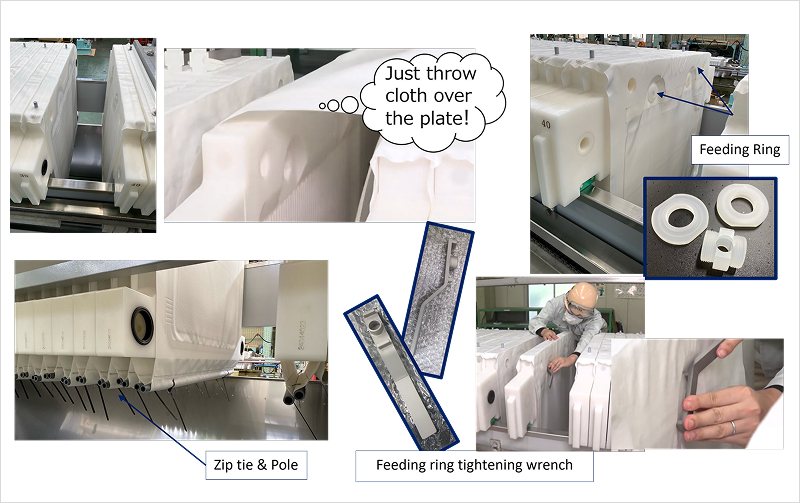
- Filter Cloth Replacement: Featuring an over-the-plate drape design, filter cloths are hung over the top of the plate and secured with side-mounted feed rings. On standard plates, the cloth can be replaced by removing the feed rings and simply pulling it upward.
- Squeezing Plates (Diaphragm): Since these plates do not have feed rings, filter cloths can be removed easily and replaced quickly, minimizing downtime.
- Touch Panel Operation: Centralizes everything from parameter settings to automated start/stop and system monitoring, enabling seamless operation with minimal human intervention.
3.3 TOUCH PANEL FUNCTIONS: SETTING, OPERATION, AND MONITORING
The TFAP series features an intuitive touch panel that streamlines the entire process— from initial parameter settings to automated start/stop and monitoring—maximizing operational efficiency while reducing manual labor.
- Operating Conditions: Set and store essential process parameters—such as filtration time, squeezing conditions, and washing cycles—as custom recipes.
- Automatic Operation: Automatically executes the entire sequence, including clamping, filtration, discharge, and washing, based on the selected recipe.
- Manual Operation: Allows independent control of specific components or automated valves for testing or maintenance purposes.
- Monitoring: Integrated with the control panel to monitor real-time equipment status, display system health, and provide instant alerts or alarms in the event of an abnormality.
3.4 GENERAL STRUCTURE OF TFAP (MAIN COMPONENTS)
The filter plates are secured by a hydraulic cylinder to perform filtration and diaphragm squeezing process. During the cake discharge process, the cylinder retracts to release the plate pack, and the dripping pan open to clear the path. As the shifting block moves the plates, the scraper automatically removes the cake, allowing it to fall through the open trays to the area below. Automating these operations ensures both stable performance and significant labor savings.
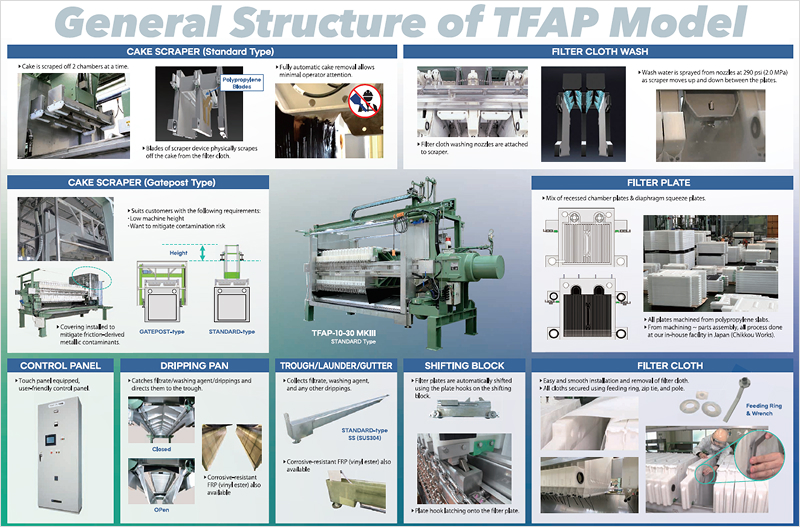
| Component | Role / Function |
|---|---|
| Hydraulic Cylinder | Applies closing force to the plate pack for filtration and squeezing, while also facilitating the opening and releasing of the plates during the discharge cycle. |
| Filter Plates / Chambers | Form the internal compartments required for filtration, cake formation, diaphragm squeezing, and cake washing. |
| Filter Cloth | Captures solid particles while allowing the filtrate to pass through. Requires regular replacement. |
| Scraper | Scrapes off the cake from the filter cloth to ensure stable and consistent discharge. |
| Dripping Pan (Drip Tray) | Collects filtrate and cloth-washing water while preventing splashing. They open during discharge to clear the path for the falling cake. |
| Plate Shifter | Sequentially moves the filter plates after opening to facilitate the cake discharge and cloth washing processes. |
4. INDUSTRIES & APPLICATIONS
Filter presses are utilized across a wide range of industries, from sludge dewatering in wastewater treatment to cake washing and filtrate recovery in manufacturing processes. The TFAP series is particularly well-suited for processes where the stability of dewatering, cake washing, and discharge performance are critical Key Performance Indicators (KPIs).
- Wastewater Treatment: Reduces waste volume through sludge dewatering, leading to lower disposal costs.
- Manufacturing Process (Cake is the Product): Effective cake washing minimizes residual impurities, ensuring consistent product purity and superior quality.
- Manufacturing Process (Filtrate is the Product/Recovery Target): Maximizes the recovery of valuable components trapped within the cake through optimized cake washing.
- Recycling: Supports the separation and recovery of valuable resources from waste streams.
Production Line
| Chemical | Pigment, Fluorescent substance, Magnetic materials, Polymerized toner |
| Non-ferrous Metal | Refining (Copper, Zinc, Lead, Titanium, Nickel, Silver, Platinum, other rare metals) |
| Foods | Sweetener, Sugar, Protein, Cooking oil, Seasoning liquid, Amino acid |
| Ceramic | Abrasive powder, Fine ceramic |
| Medicines | Antibiotic medication |
Wastewater Treatment
| Iron | Steel dust, Iron scale, Acid neutralization |
| Electric Power Plant | Pure water production process, Desulfurization, Fly ash |
| Semiconductor / Liquid Crystal Plant | CMP, Fluorine acid neutralization |
| Plating | Parts washing, Removal of fat, Neutralization |
| Cleaning Wastewater | Industrial and Municipal Wastewater |
| Other | Condenser production process |
5. STANDARD SPECIFICATIONS & LINEUP
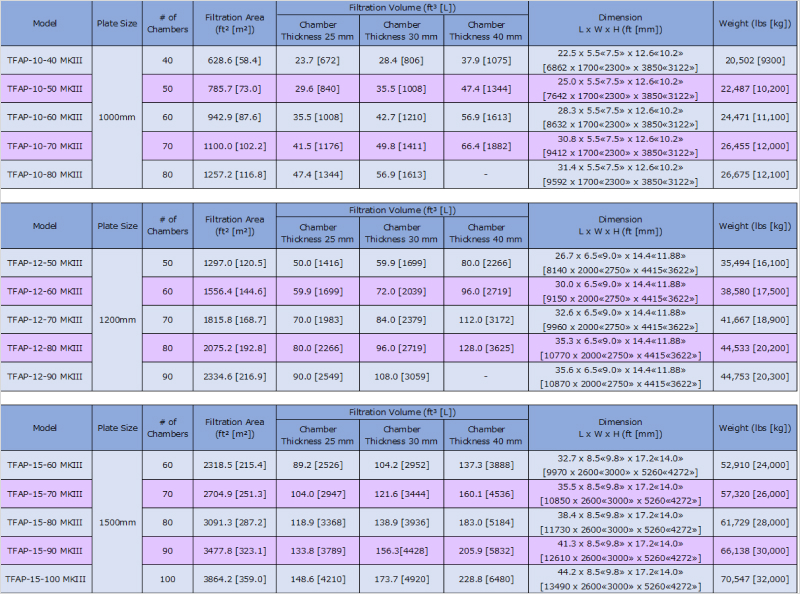
The TFAP series offers a standardized range of specifications, combining various frame sizes (e.g., 7/10/12/15 Type) with different numbers of chambers. Three chamber thicknesses are available—25, 30, and 40 mm—to suit your process requirements. Detailed dimensions and weights can be found in the specification table.
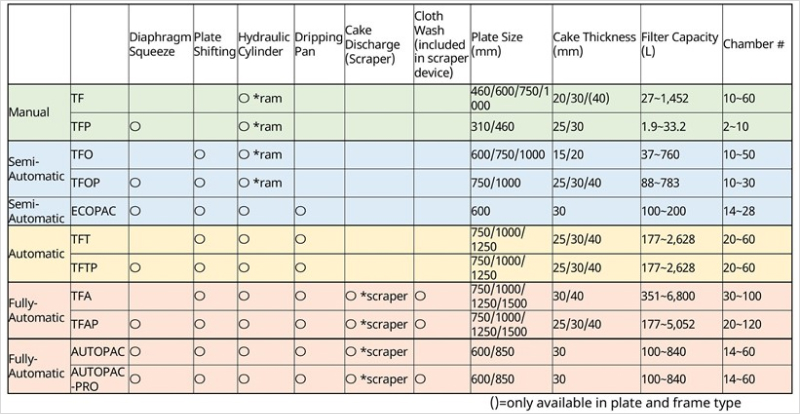
Fig.: Filter Press General Specifications (Full Lineup)
5.1 STANDARD SPECIFICATIONS TABLE
6. FILTRATION TESTS AND TECHNICAL SUPPORT
Slurry characteristics vary widely so dewatering, washing, and discharge performance depend heavily on operating conditions.
At Kanadevia, we conduct filtration tests to gather comprehensive data, supporting our customers in finalizing equipment selection and technical specifications.
- Testing Outcome: Quantitative data such as throughput (processing capacity) and cake moisture content, as well as the selection of the optimal filter cloth.
- Witnessed Testing: Clients are welcome to witness the tests. This allows clients to observe actual machine behavior firsthand while refining specifications and evaluating optimal operating conditions.
7. SEE IT IN ACTION
Visualizing operations like filter cloth replacement and cake scraper is made easier through our videos. Please visit our video library for reference clips on system operation and maintenance.
8. FREQUENTLY ASKED QUESTIONS (FAQ)
Q. Can TFAP automatically discharge highly sticky cakes?
A. The TFAP model uses a direct-contact scraper system to physically scrape off and stabilize cake discharge. Since cake behavior varies depending on stickiness, particle size, and moisture content, we recommend verifying performance through filtration test.
Q. I am concerned about uneven washing (short-circuiting or channeling)
A. Our double top-corner feed design facilitates even cake formation, while the wash water supply from the back of the filter plates ensures uniform washing across the entire cake.
Q. Can TFAP handle corrosive or alkaline slurries?
A. Yes. Our standard design features "non-metallic" wetted parts. We determine the most appropriate materials and chemical-resistant options based on the chemical properties of your slurry.
Q. For product-grade cake applications, I am concerned about metal contamination.
A. We offer an optional Gatepost-type scraper designed specifically to minimize contamination. Its structure covers the drive mechanism, effectively reducing the risk of metal powder contamination caused by mechanical wear.
9. CONTACT US – YOUR NEXT STEPS
Request For Filtration Test:
Filtration Test Consultation: Please share your slurry conditions and KPIs. We will then propose a tailored testing plan that best fits your case.
This is the fastest route to finalizing specifications. Confirming performance with your actual slurry samples is the most effective way to ensure success.
Technical Inquiry & Quotation Inquiry:
Specification and Quotation: We can work with you to design a full system layout, from the filter press to its peripheral auxiliary equipment.