
Filter Press Applications Guide: Aligning Industry Challenges with Equipment Design
Filter presses are used across a broad range of industries requiring solid-liquid separation, from municipal wastewater treatment to chemical manufacturing, battery materials, and mining. However, there is no "one-size-fits-all" solution. The performance metrics required—such as cake moisture content, cake washing efficiency, corrosion resistance, automation level, and throughput volume—vary drastically depending on the specific application.
To help US procurement managers and equipment specifiers determine the best filter press design for their facilities, this guide breaks down requirements across two distinct categories: wastewater applications and production processes. It also outlines typical industry-specific challenges and the engineering requirements needed to address them.
1. The Two Pillars of Filter Press Applications: Wastewater vs. Production Processes
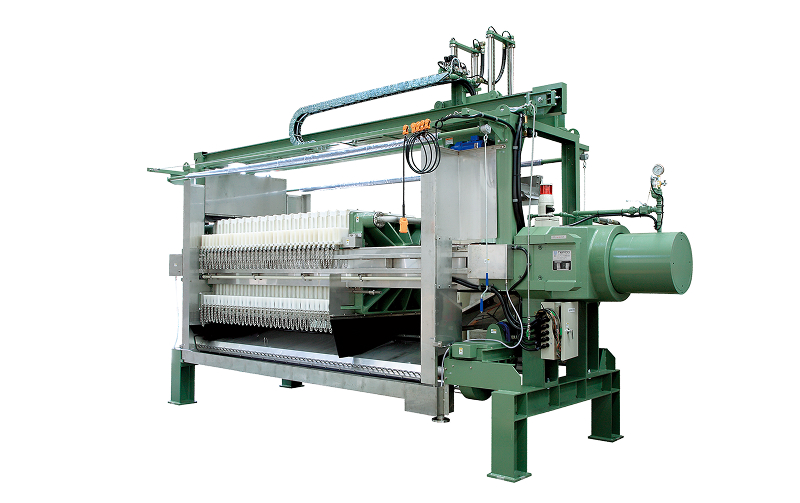
Filter press applications are broadly divided into two main categories: wastewater treatment and production processes. Determining which category your specific operation falls into will help you better align your facility's requirements with the industry-specific breakdowns provided below.
1.1 Wastewater Treatment: The Fundamentals of Sludge Dewatering and Cost Reduction
In wastewater applications, the primary economic driver is dewatering industrial effluents or plant sludge into solid cakes to minimize waste volume. Reducing cake moisture content directly lowers waste disposal and transportation fees, making cake dryness a critical key performance indicator (KPI) during the equipment selection process.
By utilizing a membrane squeeze design, facilities can often reduce cake moisture by an additional several to over ten percent compared to non-squeeze systems (though exact results vary depending on the compressibility characteristics of the specific slurry). A filter press offers a distinct competitive advantage over belt filters or centrifuges in scenarios where low moisture content is mandatory, batch operation is acceptable, and high filtrate clarity is required.
(For a systematic breakdown of core benefits—such as exceptional cake dryness, filtrate clarity, and operational advantages over other technologies—please refer to our article on the Advantages of filter press. For a direct comparison with alternative separation technologies, see Liquid Filtration. For an in-depth look at effluent treatment, refer to Wastewater filter press.)
1.2 Production Processes: How Dewatering, Cake Washing, and Recovery Dictate Product Quality
In process applications, the filter press plays a vital role in determining product quality and overall yield through three core functions: dewatering, cake washing, and recovery. In sectors like chemical manufacturing, battery materials, and pigments, achieving uniform cake washing to minimize residual impuritiesfmetallic contamination directly impacts final product purity and the recovery rate of valuable components.
Furthermore, when processing acidic or chloride-based corrosive slurries, the compatibility of wetted materials directly dictates equipment lifespan and protects product quality by eliminating the risk of metallic contamination. Unlike wastewater applications, the primary evaluation metrics shift from basic moisture reduction to cake washing efficiency, corrosion resistance, and product recovery rates.
Production Line
| Chemical | Pigment, Fluorescent substance, Magnetic materials, Polymerized toner |
| Non-ferrous Metal | Refining (Copper, Zinc, Lead, Titanium, Nickel, Silver, Platinum, other rare metals) |
| Foods | Sweetener, Sugar, Protein, Cooking oil, Seasoning liquid, Amino acid |
| Ceramic | Abrasive powder, Fine ceramic |
| Medicines | Antibiotic medication |
1.3 Application-Driven Engineering Requirements: The Core Selection Variables
Depending on your specific application, the performance metrics required from a filter press can be categorized into five core variables:
- Moisture Content: The depth of dewatering achieved.
- Cake Washing Efficiency: The uniformity of the wash and the level of residual impurity reduction.
- Corrosion Resistance: The chemical compatibility of wetted materials.
- Automation Level: The driver for equipment uptime and labor reduction.
- Throughput Capacity: Overall processing volume.
Because priorities shift drastically depending on the application, the most efficient approach is to firmly establish which of these variables is your top priority before entering the technical specification phase.
Read This Guide in the Context of Your Own Application
The performance priorities required of the system differ between wastewater treatment applications and production process applications. To support your evaluation, we provide a product catalog and consultation options tailored to your specific needs.
■ Product Catalog:
Overview of applicable industries, application examples, and system configurations.
■ Consult Us About Your Application:
Discuss your requirements based on applications and challenges similar to your own.
2. Typical Challenges and Performance Requirements by Industry (Wastewater Applications)
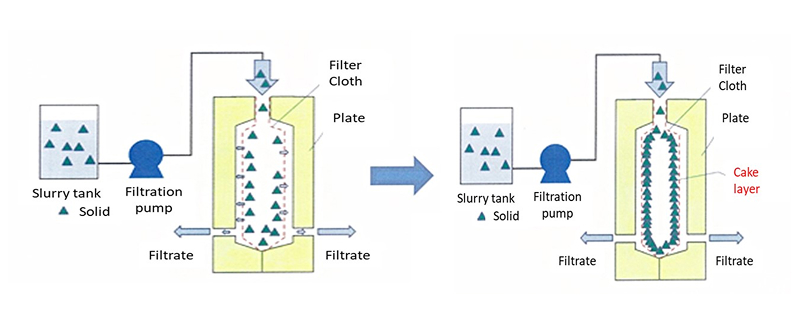
In wastewater applications, the primary economic benefits of a filter press come from reducing disposal costs and ensuring compliance with environmental regulations. Below, we break down the typical challenges faced by each industry and the key evaluation points to verify during the selection process.
2.1 Industrial and Municipal Wastewater Sludge: Sludge Dewatering
In general manufacturing plants and municipal wastewater treatment facilities, minimizing waste volume through sludge dewatering is the top priority. Disposal fees are calculated based on volume so reducing cake moisture content by even a few percentage points can lead to massive shifts in annual operating costs. Implementing a membrane (diaphragm) squeeze design is highly worth considering, as it can often reduce cake moisture by an additional several to over ten percent compared to conventional non-squeeze systems.
From a maintenance standpoint, the labor hours and frequency required for filter cloth replacement directly impact equipment uptime. Consequently, when unmanned overnight or weekend operation is required, the level of automation (automated vs. fully automated) becomes a critical selection factor.
(For a deeper look at system automation, please refer to our article on the Automatic Filter Press.)
2.2 Wastewater from Surface Treatment and Electroplating: Metal Hydroxide Sludge
In surface treatment and electroplating facilities, the primary focus is managing metal hydroxide sludge. The process fluid's pH varies drastically, spanning from highly alkaline to strongly acidic. Therefore, exposing metal components to wetted areas poses a severe risk of chemical leaks and drastically shortened equipment lifespans. Strict regulatory compliance regarding fluorides, phosphorus, and heavy metals also makes precise filtrate clarity management a critical necessity.
For these harsh environments, a metal-free wetted parts design (utilizing polypropylene and specialized rubber materials) provides a highly compatible and reliable engineering solution. Additionally, at facilities handling small-batch, high-mix production, deploying pre-packaged filtration systems (such as the AUTOPAC or AUTOPAC PRO) can significantly streamline setup and accelerate commissioning times.
(Note: Regulatory compliance and specific engineering standards for North American installations must be evaluated and verified on a case-by-case basis).
3. Industry-Specific Technical Challenges and Performance Requirements (Process Applications)
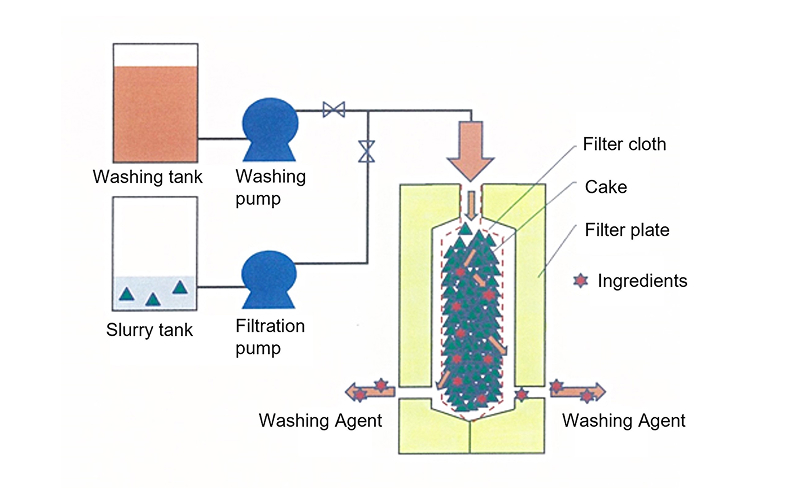
In production and process applications, equipment evaluation goes beyond simple moisture reduction. Key performance metrics include cake washing efficiency, corrosion resistance, and product recovery rates. Below is a breakdown of the typical challenges faced by each industry.
3.1 Chemical Processing: Chemical Filtration (Pigments, Catalysts, and Inorganic Salts)
In specialty chemical manufacturing—including pigments, catalysts, and inorganic salts—uniform cake washing is critical to achieving final product purity. For catalysts and functional materials, even trace metal contamination can cause catalyst poisoning, which degrades catalytic activity and ruins product quality. Therefore, selecting the right materials for all wetted parts is a critical design requirement.
Furthermore, because certain reaction steps involve highly corrosive slurries (including acidic, alkaline, or chloride-based solutions), a corrosion-resistant structure utilizing polypropylene and specialized rubber components serves as a highly compatible engineering solution. The batch nature of filter press operations also makes them an ideal fit for plants running high-mix, low-volume production lines.
3.2 Non-Ferrous Metallurgy and Rare Metal Hydrometallurgy: Leaching and Recovery
In non-ferrous smelting and rare metal hydrometallurgical processes, maximizing the recovery rate of metal ions from the filtrate via cake washing is a critical performance metric. Strict chemical compatibility for all wetted materials is a baseline requirement because these operations handle highly corrosive acidic leaching solutions.
Furthermore, handling highly adhesive leaching residues frequently triggers cake discharge failures; therefore, a robust, positive discharge mechanism heavily dictates overall plant uptime. Achieving uniform cake washing is also essential to boost recovery rates, making the engineering of the feed distribution structure vital. This application sector represents one of the ultimate tests of filter press engineering, as it simultaneously demands the highest levels of corrosion resistance, cake washing efficiency, and difficult-discharge handling.
3.3 Battery Materials: Advanced Filtration for Lithium Salts, Cathode Materials, and Recycling
The manufacturing of battery materials—including lithium salts, nickel/cobalt sulfates, and cathode precursors—demands ultra-high product purity. Tolerance for metallic contamination is exceptionally low, frequently requiring an entirely metal-free design for all wetted components. Additionally, EV battery recycling (black mass processing) is a rapidly growing sector characterized by the handling of highly corrosive leach liquors paired with ultrafine particulate matter.
Managing both aggressive corrosion and precise cake washing requirements makes battery material processing one of the most challenging environments for filter press design. This is an arena where Kanadevia’s advanced engineering expertise delivers a distinct advantage.
3.4 Food, Beverage, and Pharmaceuticals: Food and Pharmaceutical Filtration
In food processing (such as juices, beer, oils, and maple syrup) and pharmaceutical manufacturing, meeting strict sanitary standards and ensuring product purity are the top operational priorities. Because the filtrate itself is frequently the final product, filtrate clarity serves as the primary quality indicator.
Pre-coating methods (utilizing diatomaceous earth or similar filter aids) are widely adopted in these sectors. Depending on the installation, system requirements may also include Clean-in-Place (CIP) compatibility and compliance with food-contact material regulations, such as FDA standards. It is worth noting that achieving full FDA compliance across every single component of a filter press can sometimes be challenging; therefore, material specifications are typically evaluated and finalized on a case-by-case basis.
(For applications with small batch sizes or low solids concentrations where a plate and frame configuration is highly effective, please refer to our article on Plate and Frame Filtration.)
3.5 Mining and Aggregates: Mining and Aggregate Dewatering
In the mining sector, the primary applications for filter presses are mineral concentrate dewatering and the dry stacking of tailings. In this context, "mineral concentrate" refers to the slurry containing concentrated valuable minerals after the flotation process, which must be dewatered to a moisture content suitable for transport. These operations demand massive throughput so systems often require extra-large equipment profiles, utilizing 2,000 mm class plates and hundreds of square meters of filtration area. Consequently, full 24/7 automated operation is a standard selection requirement.
Additionally, driven by tightening environmental regulations, the demand for dry-stack tailings management is rapidly increasing as a sustainable alternative to traditional tailings dams.
(For a practical engineering evaluation checklist and RFP guidelines, please refer to our Industrial Filter Press article. For deep-dive technical details specific to mineral processing configurations, see our dedicated guide on the Mining Filter Press.)
4. Application Comparison Matrix: Key Requirements by Industry
The table below outlines the relative importance of the four primary evaluation metrics when selecting a filter press across different industrial applications.
| Industry/Application | Cake Moisture Rate | Cake Washing Efficiency | Corrosion Resistance | Throughput Capacity |
|---|---|---|---|---|
| General Wastewater & Sludge Treatment | High | Low | Medium | Medium to High |
| Surface Treatment & Electroplating | Medium | Medium | High | Low to Medium |
| Chemical & Pharmaceutical | Medium | High | High | Low to Medium |
| Non-Ferrous & Rare Metal | Medium to High | High | High | Medium |
| Battery Materials | Medium | Critical | High | Medium |
| Food & Beverage | Medium | High | Medium | Low to Medium |
| Mining & Aggregates | High | Low to Medium | Medium | Critical |
5. Application-Driven Selection Guide
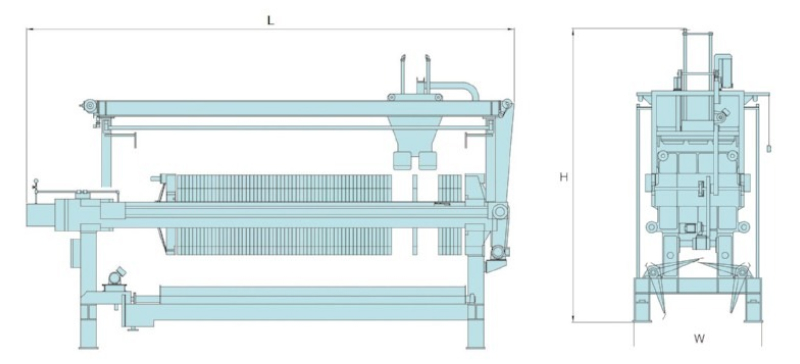
Once you have identified your specific application, the next step is to narrow down the target equipment specifications. Organizing your requirements using the following three-step framework will help streamline your evaluation process.
5.1 Characterizing Slurry Properties (pH, Temperature, Particle Size, and Adhesiveness)
Understanding your slurry's core physical and chemical properties is the critical first step in system design. Each variable directly dictates specific equipment specifications:
- pH (Acidic, Alkaline, or Neutral): Determines material selection for wetted parts to ensure chemical compatibility.
- Temperature: Dictates the allowable materials for filter plates and sealing components to prevent thermal degradation.
- Particle Size & Adhesiveness: Influences the rate of cake formation, filtration cycle times, and cake discharge efficiency.
Documenting these baseline slurry characteristics beforehand helps us provide highly accurate, tailored engineering proposals during the initial consultation.
5.2 Prioritizing Operational Objectives (Moisture Content vs. Cake Washing Efficiency vs. Equipment Uptime)
Depending on your specific application, your primary operational focus will shift between cake dryness, cake washing efficiency, and equipment uptime.
- Wastewater Sludge: Lowering moisture content (maximizing cake dryness) is the absolute top priority to reduce disposal costs.
- Chemicals & Battery Materials: High cake washing efficiency is paramount to minimize impurities and maximize product purity.
- Continuous 24/7 Operations: Maximizing equipment uptime (through robust automation) becomes the critical metric to prevent facility bottlenecks.
Because it is rarely practical or cost-effective to engineer a system that simultaneously maximizes all three variables, establishing your priorities is an essential prerequisite for finalizing technical specifications.
5.3 Transitioning to Equipment Selection and Configuration
After characterizing your application and process slurry, the evaluation shifts toward selecting the optimal plate type (chamber, membrane squeeze, or plate & frame) and defining the required level of system automation. For comprehensive technical evaluations regarding these selections, consult our reference articles: Types of Filter Press, Industrial Filter Press, and Automatic Filter Press.
Verify Performance with Your Own Slurry
Once your application requirements and performance priorities have been defined, the remaining uncertainty is whether the expected dewatering and washing performance can be achieved with your specific slurry. This can only be confirmed through testing with actual samples.
■ Filtration Testing for Application Validation:
Measure throughput, cake moisture, and washing efficiency with your slurry to support equipment selection and specification.
6. Application-Specific Operational Pitfalls and Design-Driven Solutions
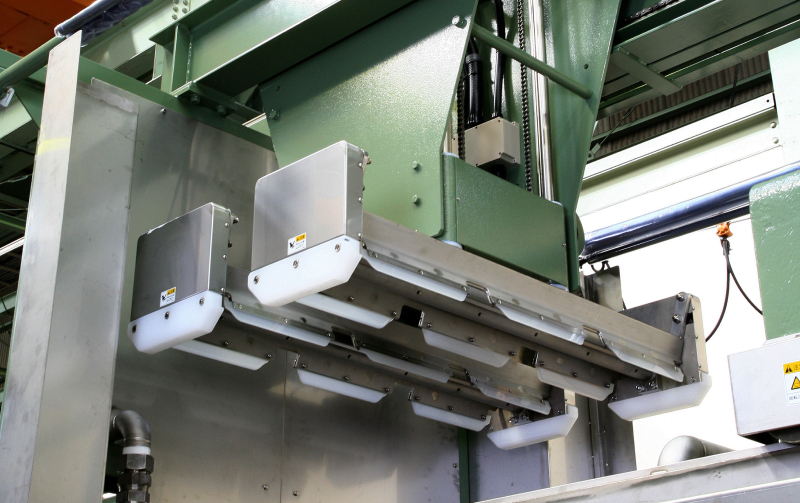
Across almost all applications, filter press operations frequently encounter four common field challenges. Proactively accounting for these issues during the initial design phase is crucial to securing both equipment uptime and final product quality.
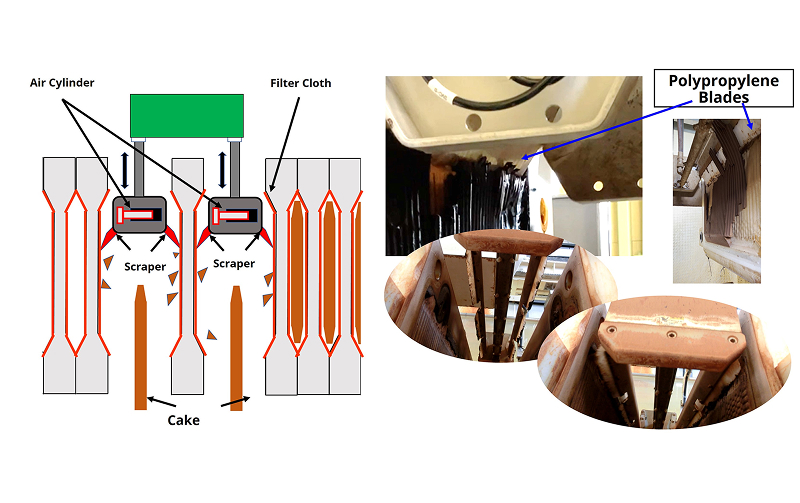
6.1 Cake Discharge Failures (Sticky Cakes): The Design Philosophy Behind Mechanical Scraper Discharge Systems
With highly adhesive slurries, the filter cake tends to stick to the cloth rather than peeling away smoothly, forcing operators to manually dislodge it. This issue is widely recognized across industrial literature as a standard technical challenge that directly impacts both equipment uptime and workplace safety. Implementing a mechanical scraper system provides a robust engineering solution, utilizing automated scraping to guarantee reliable, consistent cake discharge even when handling the stickiest materials.
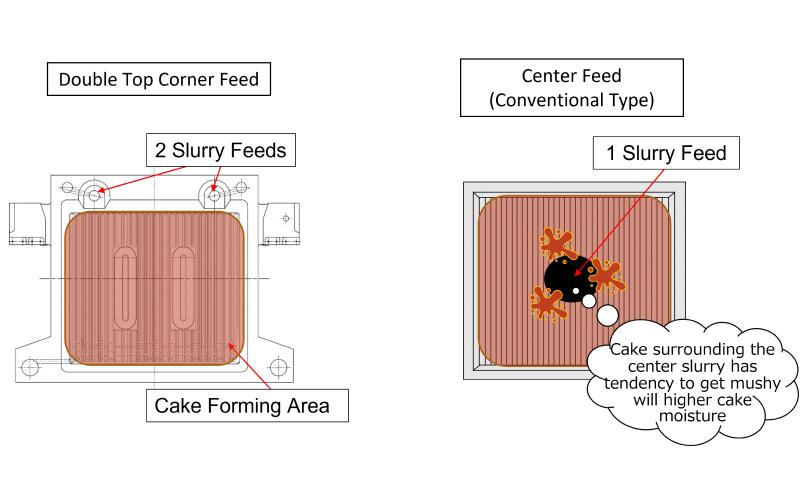
6.2 Bypassing and Channeling During Cake Washing: Achieving Uniform Slurry Distribution with Double-Top Corner Feed
When cake washing becomes non-uniform, it leads to variations in final product purity and the loss of valuable components. In most cases, this inconsistent cake washing is caused by poor distribution inherent to the slurry feed structure.
The double-top corner feed design provides an optimized feed structure that distributes slurry perfectly evenly across the chambers. This makes a definitive performance difference in applications where cake washing consistency directly impacts product quality and recovery rates—such as battery materials, non-ferrous metallurgy, and pigments.
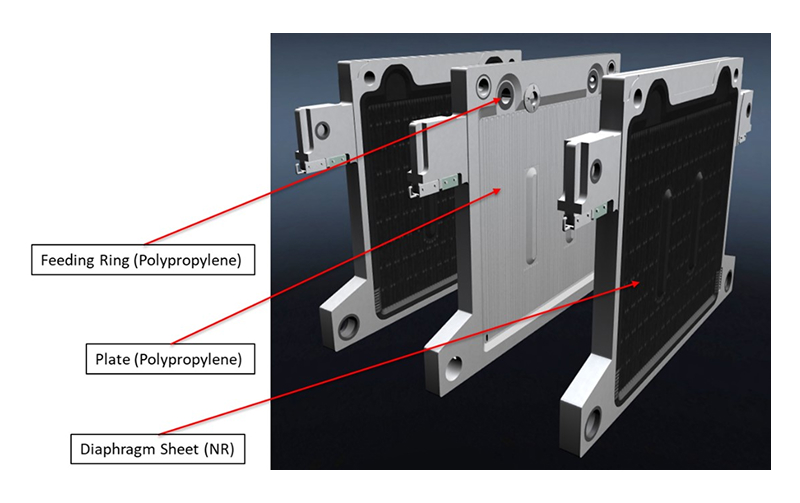
6.3 Corrosion and Metallic Contamination: The Engineering Philosophy Behind Metal-Free Wetted Parts (PP + Rubber)
When metal components are exposed to wetted areas, it introduces severe operational risks. Beyond the immediate threat of corrosion-driven leaks and shortened equipment lifespans, it creates significant quality risks—namely, metallic contamination in the product and downstream catalyst poisoning. Implementing a metal-free wetted parts design (utilizing polypropylene and specialized rubber materials) provides a highly reliable engineering solution that simultaneously addresses both corrosive slurry handling and the strict elimination of metallic contamination.
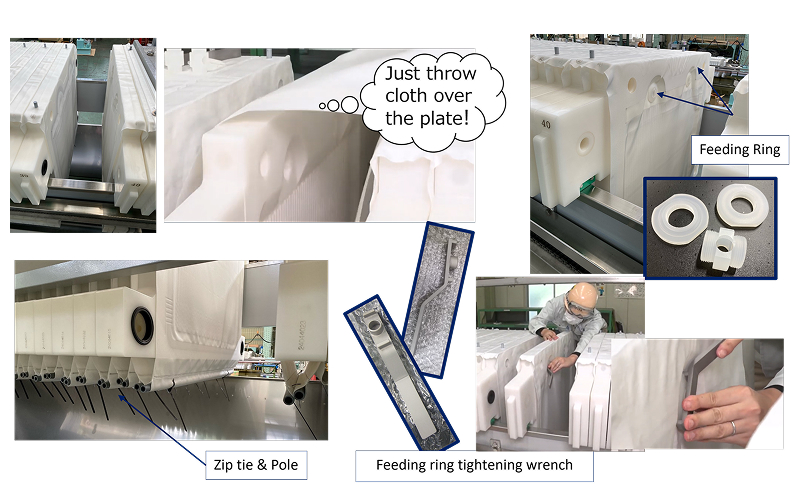
6.4 Extended Maintenance Downtime: User-Friendly Filter Cloth Design
The time and labor required to wash or replace filter cloths depend heavily on how the cloth is designed and fastened to the machine. A drape-over, drop-in cloth design significantly cuts down on maintenance hours and equipment downtime. This is especially valuable for plants running with lean maintenance teams or limited night-shift coverage.
7. Next Steps: Consulting Kanadevia for an Application-Specific Filter Press
To address the industry-specific challenges outlined above, Kanadevia’s filter presses leverage a framework of four core engineering pillars, fully backed by comprehensive laboratory filtration testing.
| Metal-Free Wetted Design (Polypropylene & Rubber Components) Engineered to eliminate metallic contamination and minimize leaks or maintenance shutdowns caused by corrosive slurries. This combination of polypropylene and rubber delivers dependable corrosion resistance in demanding acidic, chloride-based, battery material and non-ferrous operations. |
Double Top-Corner Feed Optimizes slurry distribution to eliminate variances in filtration, dewatering, and cake washing. This delivers superior performance in battery material, non-ferrous, and pigment applications where washing uniformity dictates product quality. |
| Mechanical Scraper Discharge Ensures consistent, automated cake release even with highly adhesive slurries. This mechanism minimizes manual labor, boosting both plant uptime and workplace safety. |
Drape-Over Cloth Replacement Features a drape-over cloth design that makes changeouts fast and simple. By significantly cutting down on labor hours and equipment downtime, this design relieves pressure on limited on-site maintenance personnel. |
For new slurries or projects still in the pre-finalization phase, we provide filtration testing services at our Chikko Plant laboratory. The lab setup utilizes a 350 mm single-chamber testing unit with a filtration area of 0.117 m² and selectable chamber thicknesses of 25, 30, or 40 mm. By verifying throughput capacity, target cake dryness, and the optimal filter cloth through precise test data, you can significantly increase the accuracy of your investment decisions. (For a deep dive into lab-scale filtration testing and our scale-up methodologies, please refer to our Lab Scale Filter Press article.)
Next Step
■ If Specifications are Unconfirmed:
■ If Specifications are Finalized:
■ If in the Early Planning Stages:
For a more tailored proposal, please provide the following 5 parameters when contacting us: (1) Slurry/Fluid Name, (2) Solid Concentration, (3) Intended Application, (4) Required Filtration Area, and (5) Chamber Thickness.