
Filter Press Design: How to Select Filter Plates, Structures, Feed Systems, Filter Cloths, and Automation
The design of a filter press directly determines four key performance outcomes: cake moisture content, washing purity, filtrate clarity, and processing capacity. This article breaks down the major design elements, including filter plate configuration and volume, frame and closing structure, feed systems, filter cloth selection, automation features, and site constraints. It also explains how to narrow down suitable specifications based on slurry characteristics and target performance.
For those who would like to review product features and construction details, please downloadthe Filter Press (Fully Automatic Press Filter TFAP) Catalogue.
1. What Filter Press Design Determines: Performance and the Design Process
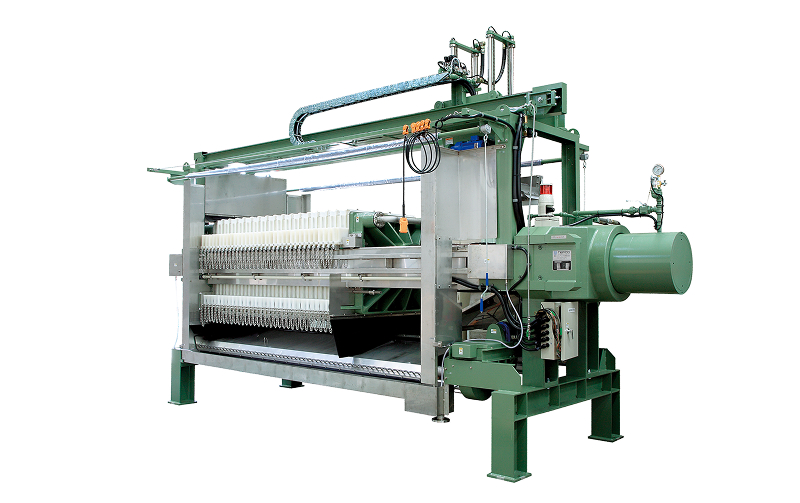
Designing a filter press is not simply a matter of determining the machine's appearance or size. It defines the operational results that can be achieved, including moisture content, washing efficiency, and throughput. This section explains the key performance indicators influenced by design and outlines a practical approach to specification development.
1.1 Four Performance Factors Determined by Design
The quality of a filter press design is ultimately reflected in four operational performance indicators. Understanding how each affects cost, product quality, and operating efficiency helps establish design priorities.
| Performance Indicator | Impact | Primary Design Factors |
|---|---|---|
| Cake Moisture Content | Disposal costs, transportation frequency, downstream drying load | Requirement for membrane squeezing, chamber thickness, squeezing conditions |
| Washing Purity | Product quality and recovery of valuable components | Feed inlet configuration and wash-flow path design |
| Filtrate Clarity | Compliance with discharge requirements and potential filtrate reuse | Filter cloth material, weave pattern, and air permeability |
| Processing Capacity | Daily throughput and required number of units | Plate size, number of plates, and cycle time |
1.2 Overview of Design Elements
The design elements of a filter press can be broadly categorized into four groups:
- Filter plates (type, chamber volume, and material)
- Structure and closing system (frame, hydraulic system, and beam support)
- Feed system, filter cloth, and automation
- Site constraints such as transportation, installation, and available space
These factors are not independent. For example, if a lower target cake moisture content is required, membrane squeezing may be necessary, which in turn affects the selection of plate type and squeeze system design. Likewise, increasing the number of plates to achieve higher throughput results in a longer press length, which impacts installation space and transportation requirements. Filter press design is therefore not about optimizing a single variable, but about balancing performance, cost, and site constraints.
▸ For a detailed explanation of filter press sizing and required filtration area calculations, see: How to size a filter press
1.3 Batch Operation and the Design Process
A filter press is a batch-operated system rather than a continuous process. Each cycle consists of:
Filtration → Dewatering → Opening → Cake Discharge.
Many design parameters depend heavily on the characteristics of the slurry being processed. Therefore, it is generally more practical to finalize specifications based on actual filtration test results rather than catalog data alone. Even with the same required throughput, the necessary filtration area can vary significantly depending on the filterability of the slurry. Using measured test data as the basis for design helps avoid both insufficient capacity and overinvestment.
2. Filter Plate Design: Type, Volume, and Material
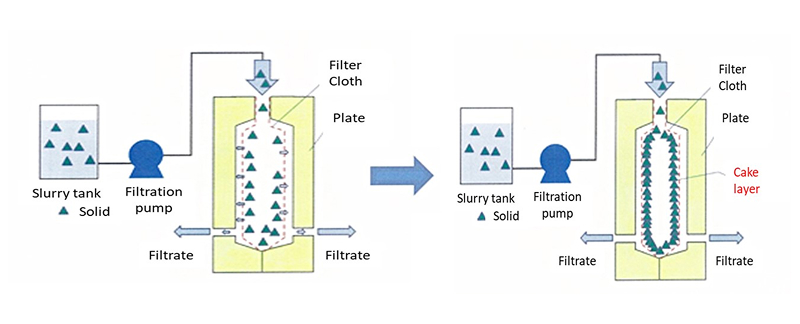
The filter plate is where the filter cake is formed, making it the starting point of filter press design. The selected plate type determines the dewatering method, the chamber volume dictates batch capacity, and the material defines chemical compatibility. This section reviews filter plate design from these three perspectives.
2.1 Plate Type and Dewatering Method: Fixed Volume or Membrane Squeeze
A chamber (recessed) plate forms a fixed-volume chamber using recessed plate surfaces. Cake formation and dewatering are achieved solely through feed pressure (filtration pressure). After filtration, the membrane is inflated to compress the cake and further reduce moisture content. It should be noted that membrane squeezing is not a separate filtration method; it is an enhanced chamber-plate configuration incorporating a membrane. A plate-and-frame press alternates plates and frames, allowing cake thickness to be adjusted by changing frame thickness. This design is selected for applications where flexible cake thickness is desirable. The choice of plate type is generally determined by the target cake moisture content and whether cake washing is required.
2.2 Chamber Volume, Chamber Thickness, and Cake Capacity
Chamber thickness (chamber depth) is selected according to the application and slurry characteristics and directly affects cake volume and batch processing capacity. Thicker chambers provide higher cake capacity per cycle but require more time to dewater the center of the cake. Thinner chambers improve dewatering efficiency but require more plates to achieve the same throughput. Kanadevia's standard chamber thicknesses are 25 mm, 30 mm, 40 mm. Required chamber volume is determined by the combination of plate size and chamber thickness.
2.3 Plate and Membrane Materials: Wetted Material Selection
Polypropylene (PP) is the most commonly used plate material because of its excellent chemical resistance and low weight. For applications requiring high strength and high operating pressure, metallic materials may also be used.
Membrane materials may include:
- PP
- Synthetic rubber (NBR / EPDM)
- Thermoplastic elastomers (TPE)
Selection is based on chemical compatibility, operating temperature, and regulatory requirements. Material selection should consider not only normal operating conditions but also cleaning chemicals and cleaning temperatures. Issues such as corrosion or metal contamination should be treated as wetted material selection problems, rather than as factors related to the filter press type itself.
▸ For more information on filter press configurations and structural differences, see: Types of filter press
3. Structural and Closing System Design: Frame, Hydraulics, and Beam Support Configuration
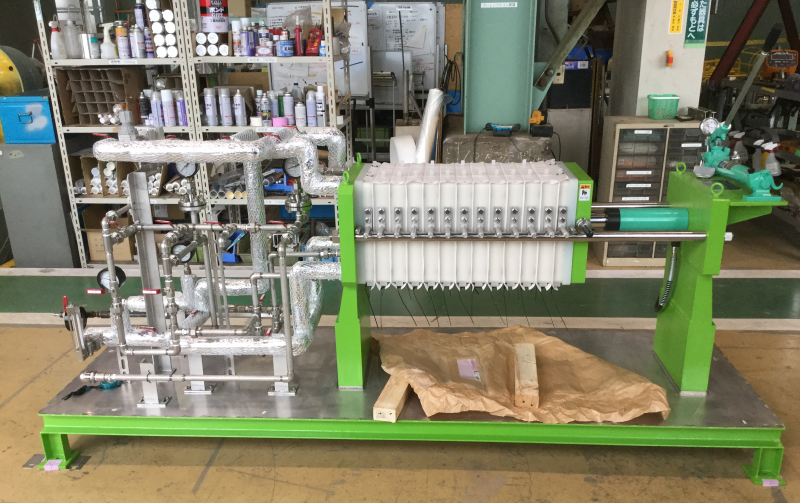
Because a filter press operates under high pressure, it requires a structure capable of withstanding and maintaining those forces. The frame and hydraulic system generate and sustain the necessary closing force, while the beam support configuration influences both equipment reliability and ease of maintenance.
3.1 Frame and Hydraulic System: The Backbone That Maintains Pressure
A filter press relies on a robust frame consisting of a fixed head and moving head, together with a hydraulic closing system, to generate and withstand the high pressures applied during operation. The hydraulic system is responsible for plate closing and opening. Insufficient closing force can lead to leakage during filtration. It is important to distinguish between filtration pressure and membrane squeeze pressure, as they serve different purposes and should be considered separately during design.
3.2 Beam Support Configuration (Overhead vs. Side-Bar)
There are two primary methods for supporting filter plates. Overhead beam systems support the plates from above. Since there are no structural members along the plate sides, access to the plates is improved, making inspection, cleaning, and maintenance easier. However, overhead systems require additional components to suspend the plates. Given the considerable weight of the plates, robust support mechanisms are necessary. Furthermore, mounting hardware requires holes in the plates, and because the plates are typically made of plastic, measures must be taken to prevent bolts and fittings from loosening or disengaging.
Side-bar systems, by contrast, simply suspend the plates from side beams. They offer a compact design and good maintainability while requiring fewer support components. Neither system is universally superior. Selection should be based on factors such as throughput requirements, available installation space, and maintenance accessibility.
4. Feed System, Filter Cloth, and Automation Design
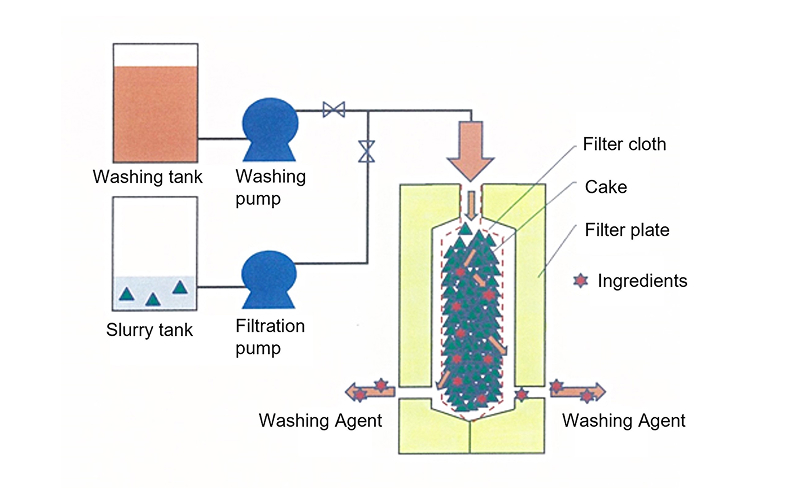
Once the plate and structural design have been determined, attention shifts to how the slurry will be fed into the press, how solids will be retained, and which operating steps should be automated. The feed system affects cake formation uniformity, the filter cloth influences filtrate quality, and automation impacts both labor requirements and plant availability.
4.1 Feed System Design
Slurry can be fed from either one end or both ends of the filter press. In large presses with many plates, dual-end feeding can reduce filling time. Feed ports may be configured as either center-feed or corner-feed systems. A corner-feed arrangement utilizes the entire filtration area more effectively and contributes to more uniform cake formation. Improper feed-port design can result in uneven cake thickness or slurry leakage from the feed port area. Some systems also incorporate a core blow step to remove residual slurry from the feed channel after chamber filling is complete.
4.2 Filter Cloth Design
Filter cloth characteristics, including material, weave pattern, air permeability, and thickness, directly affect solids capture efficiency and filtrate clarity. If the cloth is too open, suspended solids may pass through and cause cloudy filtrate. If it is too fine, premature blinding may occur, resulting in longer cycle times. A key design principle is that filter cloth specifications should be selected primarily based on filtrate clarity requirements, rather than target cake moisture content. Cake dryness is determined mainly by squeeze conditions and cycle parameters, not by the filter cloth itself.
4.3 Automation Design
The degree of automation depends on how many process steps are performed automatically, including:
- Plate closing
- Plate opening
- Plate shifting
- Cake discharge
- Cloth washing
- Condition monitoring
Based on the scope of automation, filter presses are generally classified as:
- Manual
- Semi-automatic
- Automatic
- Fully automatic
Facilities requiring 24-hour operation or labor reduction typically favor fully automatic systems, whereas semi-automatic systems may be more economical for smaller applications. Automation should not be viewed as a filter press type, but rather as a decision regarding which tasks are performed by operators and which are performed by the machine.
When evaluating automation requirements, it is helpful to assess:
- Staffing during nights and weekends
- Available maintenance personnel
- Labor hours currently spent on cake discharge
- Labor hours currently spent on cloth cleaning
This information helps determine the practical value of additional automation.
▸ For a detailed explanation of each stage of the operating cycle, please see: How does a filter press work
5. Narrowing the Design Based on Application Requirements
While the preceding sections discussed design elements individually, actual engineering projects typically proceed in the opposite direction. The process begins with slurry characteristics and performance objectives, which are then translated into appropriate design selections. This section summarizes the relationships between process inputs and design variables.
5.1 Mapping Slurry Characteristics and Performance Targets to Design Variables
To translate process requirements into filter press specifications, it is important to understand which input parameters influence which design elements.
| Input Information | Affected Design Element |
|---|---|
| pH and chloride concentration | Selection of wetted materials (plates, membranes, and seals) |
| Cake stickiness | Cake discharge method (including scraper requirements) |
| Abrasiveness | Durability requirements for filter cloths and plates |
| Solids concentration | Chamber volume and cycle design |
| Target cake moisture content | Need for membrane squeezing and squeeze conditions |
| Washing purity and recovery rate | Feed configuration and wash-flow path design |
| Throughput requirement | Plate size and number of plates |
5.2 Design Decision Matrix
The table below summarizes how major design variables generally influence cake moisture, washing performance, cake discharge stability, and maintainability.
| Design Variable | Moisture Content | Cleaning Performance | Discharge Stability | Maintainability |
|---|---|---|---|---|
| Chamber plates (without membrane) | Standard | Standard | Depends on application | Simple structure |
| Membrane squeeze | Lower moisture achievable | Standard | Depends on application | Additional membrane maintenance required |
| Corner-feed configuration | — | Improved uniformity | — | — |
| Scraper-equipped (fully automatic) system | — | — | Improved stability | Reduces manual workload and facilitates labor savings |
The evaluations shown above indicate general trends only. Actual performance depends on slurry characteristics and operating conditions. The most reliable way to determine suitability for a specific application is through filtration testing.
■ Technical Inquiry:
For assistance in selecting the optimal filter press design for your process, contact us through
■ Request For Filtration Test:
For validation using your actual slurry, request a Filtration Test through
6. Kanadevia's Design Philosophy: Corrosion Resistance, Uniform Washing, Cake Discharge, and Maintainability
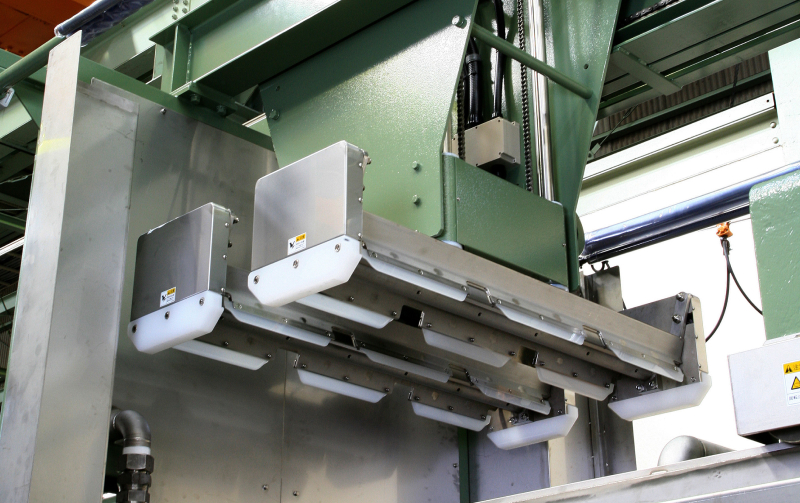
While multiple design approaches are available, this section explains how Kanadevia addresses common operational challenges through its design philosophy. The focus is on four key issues frequently encountered in industrial filtration: corrosion and metal contamination, non-uniform washing, poor cake discharge, and maintenance burden.
6.1 Metal-Free Wetted-Part Design
For processes where corrosion, leakage, maintenance costs, or metal contamination are concerns, a metal-free wetted-part design can be an effective solution. Kanadevia's filter press design utilizes polypropylene (PP) filter plates and elastomer diaphragm sheets, eliminating metal components from all wetted surfaces. For acidic or chloride-containing slurries, as well as applications where catalyst contamination must be avoided, material compatibility should be confirmed through filtration testing before finalizing the specification.
6.2 Design for Uniform Filtration, Dewatering, and Washing
Non-uniform washing directly affects product purity and valuable material recovery rates. Kanadevia's Double Top Corner Feed system introduces slurry through two upper corner feed ports, reducing flow distribution bias within the filter chambers. More uniform cake formation minimizes wash-liquid short-circuiting and improves washing consistency and reproducibility. Improved cake uniformity also reduces moisture variation throughout the cake, helping to minimize filtrate dripping when the press is opened.
▸ For a detailed explanation of cake washing methods and evaluation techniques, please refer to: Filter press cake washing
6.3 Designing for Reliable Cake Discharge and Easy Maintenance
Sticky cakes do not always discharge under their own weight, which can increase manual labor requirements and result in production interruptions. A scraper-equipped design mechanically removes cake from the filter cloth, improving discharge reliability. Similarly, filter cloth replacement systems that allow the cloth to be fitted over the plate and secured with simple retainers reduce mechanical complexity and simplify maintenance procedures, particularly in facilities with limited maintenance resources. The ease of diaphragm sheet replacement can also significantly affect maintenance downtime. For this reason, filter press design should consider not only filtration performance but also the practicality of replacing wear components throughout the equipment's operating life.
7. Incorporating Site Constraints and Avoiding Common Pitfalls
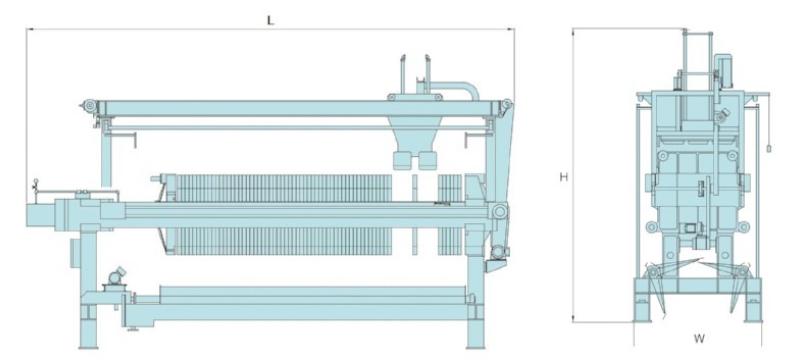
Even the highest-performing filter press provides little value if it cannot be installed or maintained within the physical constraints of the site. This section discusses practical considerations that are often overlooked during equipment selection.
7.1 Installation Space, Access Routes, and Auxiliary Equipment
Design evaluations should consider not only the footprint of the filter press itself but also:
- The overall length when the plates are opened
- Cake discharge clearance requirements
- Access-route width and ceiling-height restrictions
- Feed pumps
- Membrane squeeze compressors or high-pressure water systems
- Drainage and piping infrastructure
In retrofit projects, transportation and installation access often become critical design constraints.
7.2 Common Design Pitfalls
Several issues are frequently encountered during filter press projects:
- Incorrect sizing due to inaccurate throughput assumptions
- Leakage caused by insufficient closing force or inadequate sealing design
- Poor washing performance resulting from uneven slurry distribution
- Failure to account for the discharge characteristics of sticky cakes
- Corrosion caused by incompatible wetted materials
Most of these issues can be avoided through proper filtration testing and careful evaluation of site-specific conditions before equipment selection.
8. Moving Forward: Specification Development and Filtration Testing
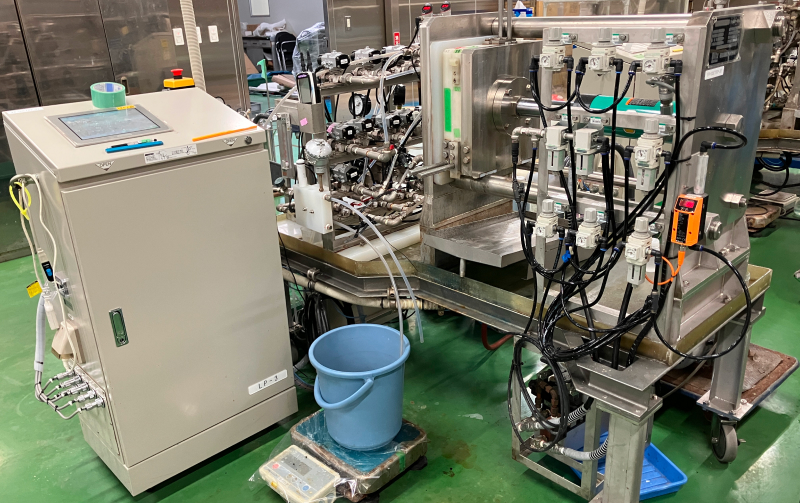
Once a preliminary design direction has been established, the next step is to validate performance using the actual process slurry. This section summarizes the information needed for equipment specification and the objectives of filtration testing.
8.1 Data Required for Specification Development
The following information is typically required to initiate a filter press design study:
- Solids concentration
- Slurry identification (composition and characteristics)
- Required filtration area
- Chamber thickness
- Process application
Filtration testing is generally conducted to evaluate:
- Achievable cake moisture content
- Filtrate clarity
- Cake release characteristics
- Cycle time
8.2 Next Steps: Consult with Kanadevia
The final filter press design is determined by balancing three key factors:
- Performance objectives
- Slurry characteristics
- Site constraints
Kanadevia provides filtration testing services at its Chikko Works laboratory in Japan, utilizing test equipment based on the same design principles as full-scale production units. Customer witness testing is also available. Because the test units share the same fundamental configuration as commercial equipment, test results can be translated more reliably into full-scale design specifications.
Next Step
■ 【For Those Who Want to Verify Performance First】
Confirm dewatering performance using your actual slurry.
Request For Filtration Test■ For consultation regarding test conditions or application suitability:
Technical Inquiry■ 【For Those Ready for Budgeting and Procurement】
Quotation Inquiry■ 【For Those Gathering Information】
Download the catalog for the TFAP Fully Automatic Membrane Filter Press, including product features and construction details.
Catalogue Download