
Filter Press Cake Washing: Methods, Washing Efficiency, and Uniform Distribution Design
Cake washing is the process of replacing the mother liquor remaining in a filter cake after filtration and dewatering with a washing liquid, thereby improving product purity and increasing the recovery of valuable components. This article explains the differences between displacement washing, counter-current washing, and reslurry washing; the key evaluation metrics of wash ratio and washing efficiency; and the relationships among liquid distribution uniformity, cake structure, and pre-dewatering performance that ultimately determine washing results. The discussion is organized to support practical equipment selection and operational decision-making.
For those who would like to learn more about the product structure and features, please download the Filter Press (Fully Automatic Compression-Type TFAP) product catalog.
1. What Is Cake Washing? Purpose, Benefits, and Suitable Applications
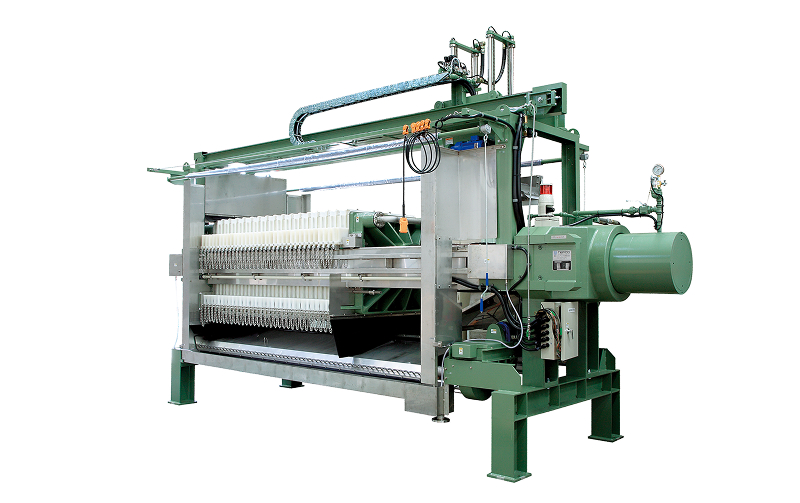
In a filter press, cake washing is the operation of replacing the mother liquor retained within the pores of the filter cake with a washing liquid. While filtration separates solids from liquids and dewatering reduces the cake moisture content, cake washing is a finishing step that changes the composition of the liquid remaining within the cake. Understanding this distinction helps facilitate subsequent process and equipment design decisions.
▸ For a detailed explanation of overall filter press operation, see: How does a filter press work
1.1 Functions of Cake Washing: Impurity Removal, Valuable Component Recovery, and Mother Liquor Replacement
The functions of cake washing can be broadly divided into three categories:
- Removal of soluble impurities remaining within the cake to improve product purity.
- Recovery of valuable mother liquor retained in the cake to increase overall process yield.
- Replacement of hazardous or undesirable mother liquor with a washing liquid, reducing the burden on downstream processing or disposal operations.
These objectives differ fundamentally from dewatering, whose primary purpose is to increase solids concentration.
1.2 Production Applications Where Cake Washing Directly Impacts Quality and Cost
The effectiveness of cake washing is particularly important in production processes where product quality and recovery rates directly affect profitability. Examples include:
- Battery materials and battery recycling
- Non-ferrous smelting operations
- Rare-metal concentrates and residues
- Chemical products
- Fine-particle materials
- Food products such as sugars and proteins
In these industries, residual impurities can lead to off-specification products, reprocessing requirements, or recovery losses.
By contrast, cake washing is generally not incorporated into applications such as industrial wastewater sludge dewatering, where the cake is disposed of rather than recovered as a valuable product.
Whether cake washing is required depends primarily on how the cake is positioned within the process:
- Valuable product: Cake washing is often essential to maximize purity and recovery.
- Waste for disposal: Cake washing is generally unnecessary.
Clarifying this distinction at the beginning of a project helps streamline equipment specification and process design.
▸ Industry-specific application examples are summarized here: Filter press applications
2. Types of Cake Washing Methods: Displacement Washing, Feed Washing, Counter-Current Washing, and Reslurry Washing
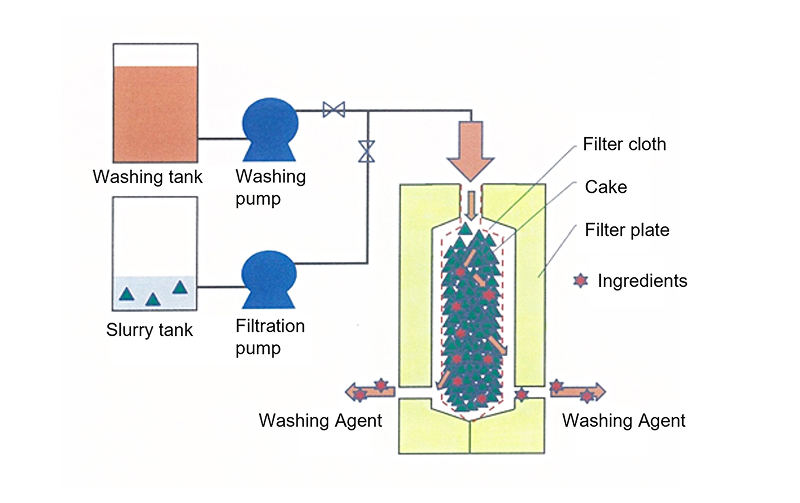
Cake washing methods can be categorized by where the wash liquid is introduced and how it flows through the cake. The following sections review each method from the common perspectives of operating principle, suitable applications, and key considerations.
2.1 Displacement Washing: The Basic Method of Pushing Out Mother Liquor
Displacement washing is a method in which the mother liquor remaining within the pores of the filter cake after filtration is displaced and replaced by wash liquid introduced through the same flow path used for slurry feeding. This is the most common cake washing method used in filter presses and can effectively remove soluble impurities while minimizing wash liquid consumption.
However, if the cake is formed unevenly across the filtration area or if cracks develop within the cake, the wash liquid may channel through preferential flow paths, resulting in insufficient displacement. Therefore, uniform cake formation is a prerequisite for achieving effective displacement washing.
2.2 Feed Washing and Counter-Current (Back) Washing: Differences in Wash Liquid Flow Path
There are two principal approaches to introducing wash liquid into a filter press.
Feed washing introduces the wash liquid through the slurry feed port, following the same general flow direction as filtration.
Counter-current (back) washing introduces the wash liquid from the filtrate discharge side, forcing it through the cake in the reverse direction before discharging it from the opposite corner.
Because back washing introduces the wash liquid from the filter cloth side, the direction of liquid flow through the cake differs from that of feed washing.
Kanadevia’s fully automatic compression-type filter press supports both washing configurations, allowing the most appropriate method to be selected based on process requirements.
2.3 Reslurry Washing: Cake Washing by Redispersion
Reslurry washing involves redispersing the filter cake into a wash liquid and then refiltering the slurry. This method can be effective when treating fine particles or porous materials in which impurities are difficult to remove because mass transfer is diffusion-limited and residual mother liquor remains trapped within particle structures.
However, reslurry washing requires additional equipment such as dedicated slurry tanks and agitators, and it generally consumes a substantially larger volume of wash liquid.
For this reason, performing cake washing directly within the filter press is usually the more economical and desirable approach, provided that the filter press itself delivers sufficiently high cake-washing performance.
3. Understanding Washing Performance: Wash Ratio, Washing Efficiency, and Residual Content
To evaluate the effectiveness of cake washing, quantitative performance indicators are required. Two of the most commonly used metrics are wash ratio and washing efficiency.
3.1 Wash Ratio and Washing Efficiency: Defining Performance Targets
The wash ratio is defined as the volume of wash liquid introduced divided by the volume of liquid retained within the cake.
Washing efficiency, on the other hand, is defined as the volume of liquid within the cake that has been replaced by wash liquid divided by the total volume of liquid retained in the cake.
A washing efficiency of 100% corresponds to complete replacement of the mother liquor, whereas a washing efficiency of 80% indicates that 20% of the liquid remaining in the cake is still mother liquor.
Depending on the process conditions, relatively high recovery rates may sometimes be achieved even at modest wash ratios. Factors such as temperature and pressure can also affect impurity dissolution and removal. Because performance depends on many operating variables, these values are most useful when interpreted as process trends rather than absolute targets.
3.2 Washing Curves and the Three Washing Regions
The progression of cake washing is often best understood through a washing curve, which plots residual impurity concentration against wash ratio.
Initially, washing proceeds through a displacement region, where a large fraction of the mother liquor is rapidly replaced by wash liquid.
This is followed by an intermediate region, after which the process enters a diffusion-controlled region. In this stage, impurities are removed mainly through diffusion from within particles or from pores that are difficult for the wash liquid to access.
For difficult-to-wash fine particles, the diffusion-controlled region often dominates the overall process, resulting in longer washing times.
Understanding where a process reaches diminishing returns on the washing curve helps establish realistic expectations for both wash water consumption and washing duration. If residual impurity levels cease to decrease despite increasing wash liquid volume, it is often more effective to reconsider the cake washing method itself or optimize upstream operating conditions rather than simply adding more wash water.
4. Key Variables Affecting Cake Washing: Liquid Distribution, Cake Structure, and Pre-Dewatering
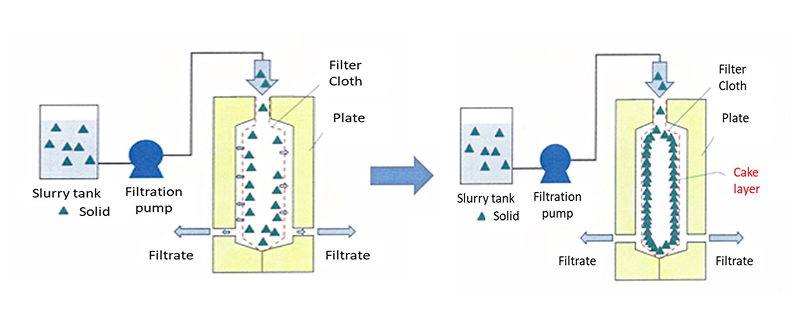
The effectiveness of cake washing depends largely on whether the wash liquid is distributed uniformly throughout the cake and on the physical condition of the cake itself.
4.1 Washing Non-Uniformity (Short-Circuiting and Channeling) and Its Impact on Purity and Recovery
When an uneven cake is formed across the filtration area or cracks develop within the cake, wash liquid distribution near the filter cloth surface becomes non-uniform. As a result, the wash liquid may preferentially flow through only part of the cake, creating short-circuiting (short-pass flow) paths and leaving other regions insufficiently washed.
This can lead to variations in product purity and lower recovery rates, ultimately increasing processing time and operating costs due to the need for rewashing.
In practice, cake washing performance often depends more on distribution uniformity than on wash liquid volume alone. If short-circuiting occurs, simply increasing the amount of wash water is unlikely to improve results, since the additional liquid will continue to follow the same preferential flow paths while poorly washed regions remain unaffected.
4.2 Cake Structure, Fine Particles, Pre-Dewatering, and Wash Liquid Permeability
Characteristics of the cake itself also have a major influence on washing performance. Fine-particle layers and cake compressibility can significantly alter the flow pattern of the wash liquid through the cake.
Applying a preliminary squeezing or pre-dewatering step before washing reduces the amount of mother liquor retained within the cake and minimizes mixing between the mother liquor and the incoming wash liquid.
However, excessive dewatering can make the cake overly compact, reducing wash liquid permeability and making the cake more difficult to wash effectively.
As a result, upstream dewatering must be carefully optimized. Both insufficient and excessive dewatering can negatively affect washability. Determining the appropriate balance is therefore a key factor in process design. Specific guidelines for selecting suitable washing methods are discussed in Chapter 6.
5. Position of Cake Washing Within the Operating Cycle: Relationship with Filtration and Compression
Cake washing is not an isolated operation. It is one step within the overall filter press cycle, positioned between filtration and final cake compression. The timing of the washing step and the way dewatering is managed before and after washing can significantly influence washing effectiveness.
This section explains where cake washing fits within the operating cycle and how it interacts with the surrounding process steps.
5.1 Process Sequence: Filtration → Cake Washing → Compression → Cake Discharge
A typical filter press operating cycle consists of the following steps:
Filtration → Cake Washing → Compression → Cake Discharge
Cake washing is generally performed before the final compression stage because compression densifies the cake structure, making it more difficult for the wash liquid to pass through the cake.
In some Kanadevia applications, a preliminary compression step may be performed before washing. The objectives are:
- To reduce the amount of mother liquor retained in the cake prior to washing.
- To improve cake stability and help prevent short-pass flow during the washing step.
By decreasing the amount of retained mother liquor before washing, replacement efficiency can be improved while maintaining more uniform liquid distribution throughout the cake.
Because the washing step also contributes to overall cycle time, the required wash water volume and washing duration should be designed in conjunction with throughput targets and production requirements.
■ Technical Inquiry:
For consultation regarding washing objectives, required purity levels, and process design:
■ Request For Filtration Test:
For customers wishing to evaluate washing performance using actual process slurry:
6. Evaluation and Design Considerations for Cake Washing Performance
The effectiveness of cake washing must be evaluated quantitatively rather than subjectively. In addition, achieving stable washing performance depends not only on operating conditions but also on equipment design. This chapter discusses four key aspects of cake washing performance: quantitative evaluation methods, design approaches for uniform liquid distribution, selection of washing methods, and compatibility between wash liquids and wetted materials.
6.1 Quantitative Evaluation of Cake Washability: Conductivity and pH Measurement
Cake washability can be evaluated by measuring the conductivity and pH of the wash water discharged during the washing process. At the beginning of washing, the concentration of impurities is relatively high, resulting in high conductivity. As cake washing progresses and impurities are removed, the conductivity gradually decreases.
When pH is used as an indicator, a similar trend can be observed, with the pH of the discharged wash water gradually approaching that of the wash liquid itself.
By monitoring these changes over time, the wash water volume and washing duration required to reach the target cleanliness level can be quantitatively determined.
For applications where recovery rate and product purity are critical, conductivity and pH measurements are valuable evaluation parameters in laboratory filtration and washing tests.
6.2 Designing for Uniform Distribution: Double Top Corner Feed and Counter-Current Washing
One of the most important factors in minimizing washing non-uniformity is the uniform distribution of both slurry and wash liquid.
Kanadevia's Double Top Corner Feed configuration introduces slurry through two upper corner feed points, reducing flow distribution bias within the filter chamber and enabling more uniform filtration, dewatering, and cake washing.
When a uniform cake structure is formed, the likelihood of cracking and short-circuiting is reduced, allowing the wash liquid to follow the intended flow paths throughout the entire cake. This improves washing efficiency and helps achieve more consistent product quality and recovery.
6.3 Selecting the Appropriate Cake Washing Method
Cake washing is not a one-size-fits-all operation. The most suitable method depends on slurry characteristics, product requirements, and process constraints.
Kanadevia commonly employs the following cake washing methods:
Back Washing
In this method, cake washing is performed simultaneously with membrane compression.
Because the cake is held under compression while wash liquid passes through it, the formation of short-circuit flow paths can be minimized, resulting in more effective washing.
Soaking Washing
Wash liquid is retained within the cake for a specified period before discharge.
This method is particularly useful for impurities that are difficult to remove through displacement alone and require additional diffusion time to migrate from within particles or poorly accessible pores.
Backpressure Washing
When cake permeability is high and wash liquid passes through the cake too quickly, backpressure can be applied to slow the flow rate.
This extended contact time between the wash liquid and the cake improves washing effectiveness.
Intermittent Washing
This method alternates between washing and dewatering steps.
By repeatedly replacing and removing retained liquid, mother liquor displacement can be carried out in stages, improving overall washing performance.
The selection of the most appropriate method depends on:
- Slurry characteristic
- Required product purity
- Target recovery rate
- Available wash water volume
- Cycle time requirements
For reliable process design, actual slurry testing is recommended to determine the wash water volume and washing duration required to meet performance targets.
6.4 Wash Liquid Compatibility and Wetted Materials: Preventing Corrosion and Metal Contamination
Cake washing may involve acidic, alkaline, or other chemically aggressive wash liquids, making compatibility between the wash liquid and wetted materials a critical design consideration.
Corrosion of wetted components can lead to leakage, unscheduled maintenance, and production downtime. In severe cases, dissolved metals may contaminate the product and compromise product quality.
Importantly, this issue is not a function of filter press type, but rather of the materials used in wetted parts.
Kanadevia employs a metal-free wetted-part design consisting primarily of polypropylene (PP) and elastomer materials such as NR, EPDM, and PP, providing broad compatibility with a wide range of wash liquids and helping minimize the risk of corrosion and metallic contamination.
▸ For additional information on equipment design, including wetted material selection, see: Filter press design
7. Comparison and Selection of Cake Washing Methods: How to Choose Based on Your Objective and Common Pitfalls
Based on the washing methods and influencing factors discussed above, this section summarizes how to select the most appropriate approach for your process. The optimal cake washing method depends on the required purity level, recovery rate, available wash liquid volume, and slurry characteristics. After comparing the differences at a glance, we will review the key information needed for evaluation and the common pitfalls to avoid.
7.1 Comparison of Cake Washing Methods
The three washing methods discussed above are compared below in terms of mechanism, suitable conditions, and key considerations. In practice, these methods are sometimes combined. Therefore, selection should be based on process objectives rather than a simple ranking of advantages and disadvantages.
| Method | Mechanism | Suitable Conditions | Considerations |
|---|---|---|---|
| Displacement Washing | Wash liquid is introduced from the feed side to displace the mother liquor through the cake. | Removal of soluble impurities; applications where wash liquid consumption should be minimized. | Requires uniform cake formation. Be careful of channeling or short-circuiting. |
| Back Washing | Wash liquid is introduced from the filtrate side in the reverse direction. | Applications requiring cleaning of the fine particle layer near the filter cloth surface. | Requires appropriate flow path design and equipment capability. |
| Reslurry Washing | The cake is re-dispersed into a slurry and filtered again. | Fine or porous particles where mother liquor trapped within the particles must be removed. | Requires additional tanks and agitators. Water consumption is relatively high. |
7.2 Selection Checklist and Verification Through Filtration Testing
When evaluating cake washing methods, the following information should be clarified:
- Target purity level and/or recovery rate
- Type of impurities to be removed
- Available wash liquid and limitations on wash liquid volume
- Daily processing capacity and cycle time requirements
Providing this information allows a more detailed evaluation of both the washing method and equipment specifications.
The most reliable way to verify actual washing performance is through filtration testing using the real slurry, while monitoring changes in filtrate conductivity during washing.
For quotation and preliminary design purposes, having the following five items available enables discussion of cycle design including the washing stage:
- Solids concentration
- Process liquid name
- Required filtration area
- Chamber thickness
- Application or intended use
7.3 Common Pitfalls: Channeling, Residual Impurities, and Excessive Wash Water Consumption
There are three common challenges encountered in cake washing:
1. Channeling and Residual Impurities
If cake formation is uneven or cracks develop within the cake, the wash liquid may bypass portions of the cake through preferential flow paths. As a result, impurities can remain trapped inside the cake.
2. Excessive Dewatering Before Washing
Over-dewatering prior to washing can harden the cake, making it more difficult for wash liquid to pass through. This reduces washing efficiency.
3. Increasing Wash Water Without Improving Washing Performance
Simply increasing wash water volume without addressing washing efficiency can significantly increase wastewater generation and treatment costs while providing limited improvement in impurity removal.
In many cases, these issues can be mitigated through uniform cake formation and proper control of the preceding filtration and dewatering stages. If cake washing performance is unsatisfactory, it is often beneficial to review the upstream filtration and dewatering conditions rather than focusing solely on the washing parameters.
8. Next Step: Consult Kanadevia
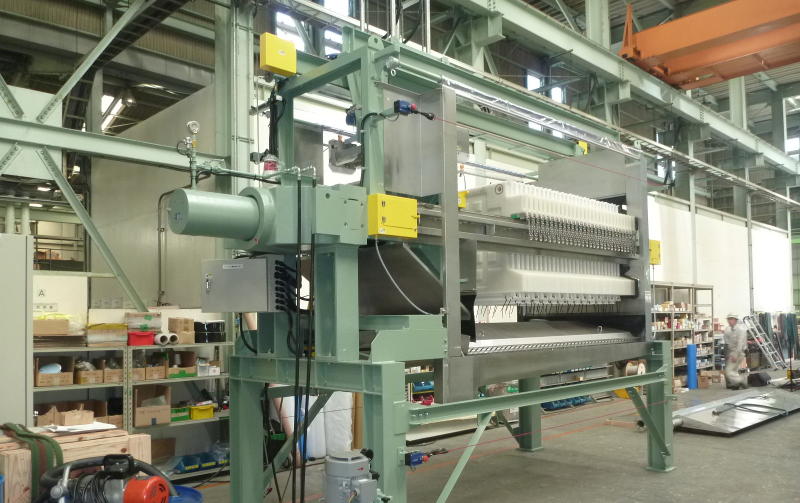
Successful cake washing depends less on the absolute volume of wash liquid and more on whether the wash liquid is distributed uniformly throughout the entire filter cake.
At Kanadevia, uniform filtration, dewatering, and cake washing are achieved through the Double Top Corner Feed design philosophy. Filtration testing using pilot equipment with the same structure as commercial machines is available at the Tsukiko Factory Laboratory in Japan, with on-site participation also possible.
To facilitate a smooth evaluation process, please provide:
- Solids concentration
- Process liquid name
- Required filtration area
- Chamber thickness
- Application or intended use
Next Step
■ 【For Those Who Want to Verify Performance First】
Cake washing performance can be evaluated using your actual slurry.
Request For Filtration Test■ 【For consultation regarding test conditions or application suitability】
Technical Inquiry■ 【For Those with Defined Specifications】
Quotation Inquiry■ 【For Initial Information Gathering】
Download the product catalogue for the Fully Automatic Press Filter (TFAP), including structure and key features.
Catalogue Download