
Filter Press Sizing: How to Determine the Required Filtration Area and Number of Filter Plates
A filter press operates in batch mode, so sizing should be based not on instantaneous flow rate, but on how much material must be processed per cycle. This article explains the practical sizing procedure, from organizing the required input data to determining dry solids mass, understanding the relationship between filtration area and cake thickness, evaluating cycle time and processing capacity, and finally selecting the appropriate plate size and number of plates.
If you would like to review the product structure and features, please download the brochure for the Filter Press (Fully Automatic Compression Type TFAP) here:
1. What Is Filter Press Sizing?
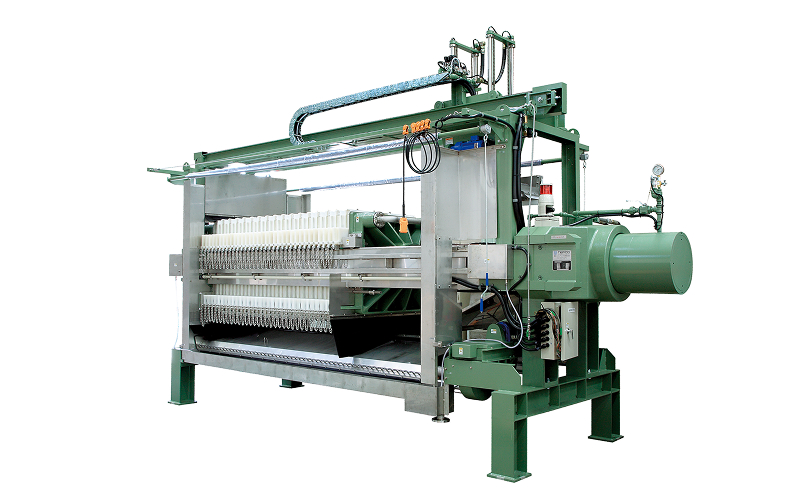
The capacity of pumps and continuous-process equipment is usually expressed as a flow rate per minute. A filter press, however, operates in batches and therefore requires a different approach to equipment selection.
The key questions are: how much filter cake can be retained in one cycle, and how many cycles can be completed per day? The product of these two values determines the overall processing capacity.
1.1 Fundamentals of Batch Operation and Sizing
A typical operating cycle consists of:
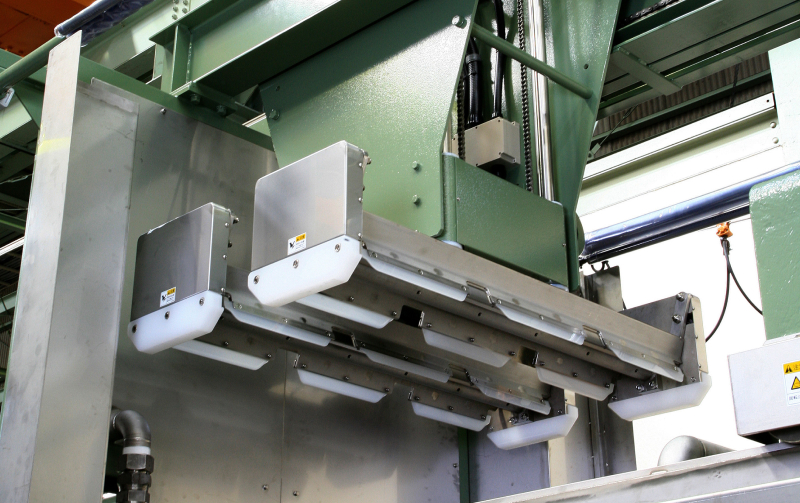
Plate closing → Filtration → Washing (if required) → Membrane squeezing → Cake discharge → Cloth washing.
This sequence is repeated throughout operation.
The amount processed in a single cycle is determined by the filter chamber volume, while the number of cycles per day depends on the cycle time and the available operating hours. Consequently, sizing is essentially the process of breaking down the target daily throughput into these two variables.
One important point to note is that increasing chamber thickness does not automatically increase throughput. A thicker chamber holds more solids, but it also requires more time to dewater the central portion of the cake. As a result, cycle time becomes longer. Therefore, the amount processed per cycle and the number of cycles per day are in a trade-off relationship.
1.2 What Happens When Sizing Is Incorrect?
If the filter press is undersized, the required processing capacity cannot be achieved, resulting in extended operating hours or the need for additional equipment.
Conversely, an oversized system leads to unnecessary capital investment, larger installation space requirements, and increased maintenance costs.
A common mistake is to overestimate the filterability of the slurry. When actual filtration times exceed the design assumptions, the equipment may fail to achieve the planned throughput.
Sizing errors are often discovered only after startup, and corrective actions typically require equipment additions or operational changes, both of which can be costly and disruptive. Careful verification during the sizing stage therefore plays a critical role in improving the accuracy of investment decisions.
2. Input Data Required for Filter Press Sizing
The accuracy of filter press sizing is largely determined by the quality of the available process data. The required inputs can be grouped into three categories:
- Target throughput and available operating time
- Slurry characteristics
- Equipment design and operating conditions
Among these, slurry characteristics are often the most difficult to define because many critical parameters can only be determined through filtration testing. The extent to which these properties are verified through actual testing has a significant impact on sizing accuracy.
2.1 Throughput, Operating Hours, and Number of Cycles
The starting point is the required daily throughput, expressed either as slurry volume or dry solids mass, together with the available operating hours per day.
The number of cycles per day can be estimated by dividing the available operating time by the cycle time. Once the number of cycles is known, the required processing quantity per cycle can be determined by dividing the daily throughput by the number of cycles.
When defining operating hours, it is important to use the actual production time, excluding periods required for preparation, cleaning, maintenance, and other non-productive activities.
In addition, if throughput varies due to seasonal conditions or production schedules, sizing should be based on the expected peak load rather than the average load. Where designing for peak demand would result in an excessively large filter press, alternative approaches such as extending operating hours or utilizing buffer tanks should also be considered.
2.2 Solids Concentration and Target Cake Moisture Content (Variables Determined by Testing)
The solids concentration of the slurry determines how much filter cake can be generated from a given slurry volume.
The target cake moisture content, meanwhile, influences whether membrane squeezing is required and what squeezing conditions should be applied.
These parameters cannot be established solely through theoretical calculations. They are variables that should be determined through testing with the actual slurry. In particular, filterability, or the time required to form a cake of a specified thickness, can vary significantly depending on the characteristics of the slurry.
2.3 Cake Thickness, Temperature, and Automation Level
Filter chamber thickness typically depends on the slurry properties, with 10 mm to 40 mm being a common range. Increasing chamber thickness allows more solids to be processed per cycle, but it also increases the dewatering time required for the center of the cake.
Temperature affects slurry viscosity and therefore has a direct influence on filtration rate. The level of automation affects cycle time through factors such as cake discharge and filter cloth washing duration.
▸ For a detailed explanation of design parameters, including chamber thickness, please refer to: Filter press design
3. Sizing Based on Mass Balance
Ultimately, the required filter press size is determined by one key question:
How much solid material must be retained as filter cake?
This section explains the sizing process starting from the mass of solids contained in the slurry and translating that quantity into the actual cake volume that must be accommodated inside the filter chambers.
3.1 Starting with Dry Solids Mass
The foundation of filter press sizing is the amount of dry solids processed per cycle.
The mass of solids contained in the slurry can be calculated from the slurry flow rate and solids concentration. Since these solids must be retained within the filter chambers as filter cake, the required chamber volume can then be estimated.
Determining the dry solids mass on a per-cycle basis therefore provides the first approximation of the filter press capacity required for the application.
3.2 Converting to Wet Cake Volume
Because filter cake always contains residual moisture, sizing must be based not only on the dry solids mass but also on the target cake moisture content.
A higher moisture content results in a larger cake volume and greater wet cake mass, even when the amount of dry solids remains unchanged.
This relationship also explains why reducing cake moisture content can significantly lower disposal and transportation costs. For example, reducing moisture content from 85% to 70% can nearly halve the wet cake mass while maintaining the same quantity of dry solids.
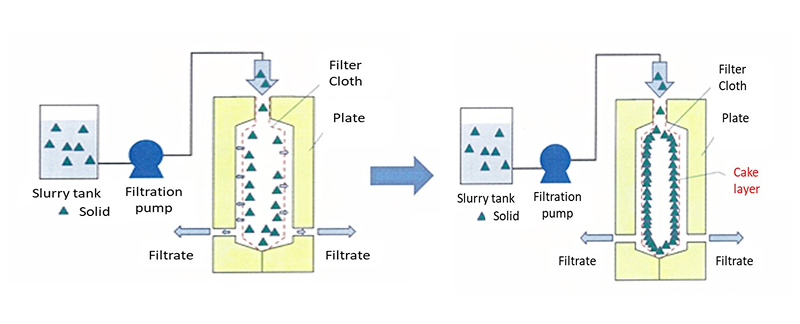
During filtration, the solids contained in the feed slurry are retained on the surface of the filter cloth and gradually form a cake layer, while the liquid phase passes through the cloth and exits the press as filtrate.
4. Relationship Between Filtration Area, Chamber Volume, and Cake Thickness
Once the required filter chamber volume has been determined, the next step is to break it down into filtration area and cake thickness. The same chamber volume can be achieved through different combinations of area and thickness, and the selected combination has a direct impact on equipment configuration and cycle time. It is also important to consider an appropriate design safety factor during sizing.
4.1 Determining Filtration Area from Chamber Volume and Cake Thickness
Filter chamber volume can be considered as the product of filtration area and cake thickness (chamber depth).
Once the required chamber volume has been established, the selected chamber thickness determines the required filtration area. In other words, for the same chamber volume, multiple design configurations are possible.
For example, the design may use:
- A larger number of thin chambers, or
- A smaller number of thick chambers
Thin chambers generally allow dewatering to progress more efficiently, resulting in shorter cycle times. However, they require a greater number of filter plates, which increases the overall machine length.
Thicker chambers provide the opposite characteristics. Fewer plates are required, allowing for a more compact machine footprint, but the dewatering process tends to take longer, increasing the cycle time for each batch.
4.2 Effective Filtration Area and Safety Factors
The filtration area specified in the catalog corresponds to the effective filtration area available in the actual filter press.
A safety factor is applied to account for uncertainties associated with scaling up from filtration test results to full-scale operation, as well as the risk of variations in slurry characteristics caused by seasonal changes or differences in raw materials.
The appropriate safety factor should be determined based on the expected variability of the slurry properties and the potential impact that insufficient filtration capacity would have on the operation.
5. Cycle Time and Processing Capacity
Determining the chamber volume alone is not sufficient to calculate daily throughput.
The actual processing capacity depends on how many operating cycles can be completed within the available operating time. This is governed by the cycle time.
This section outlines the individual cycle components and the factors that can extend their duration.
5.1 Components of the Cycle Time
Cycle time is the sum of the duration of each operating step.
Understanding what affects each step makes it easier to identify opportunities for cycle-time reduction and productivity improvement.
| Process Step | Main Factors Affecting Time |
|---|---|
| Plate Closing | Equipment size, hydraulic system capacity |
| Filtration | Slurry filterability, solids concentration, filtration pressure, cake thickness |
| Cake Washing | Washing water volume and washing method (if required) |
| Membrane Squeezing | Squeezing pressure and target cake moisture content |
| Cake Discharge | Degree of automation and cake release characteristics |
| Cloth Washing | Washing method and cleaning frequency |
The sum of these individual times constitutes the total cycle time. Dividing the available operating hours by the cycle time gives the number of cycles that can be completed per day.
Because filtration time is highly dependent on slurry characteristics, actual filtration test data are extremely valuable for estimating realistic cycle times and sizing equipment accurately.
▸ For a detailed explanation of each operating step, see: How does a filter press work
5.2 Difficult-to-Filter Slurries and Pretreatment
Slurries containing a high proportion of fine particles and exhibiting high compressibility tend to form a dense cake layer near the filter cloth surface. As a result, filtration resistance increases rapidly, leading to longer filtration times.
In such cases, filtration performance can often be improved through pretreatment methods, such as the addition of flocculants or coagulants, which promote particle agglomeration and enhance cake permeability.
Another common approach is to review and optimize the filter cloth specification, including the weave pattern, permeability, and material selection.
Whether pretreatment is required should be evaluated during the sizing stage, as it can significantly affect filtration rates, cycle times, and ultimately the size of the filter press required for the application.
■ Technical Inquiry:
If you would like assistance selecting a filter press based on your required throughput and operating conditions, please contact us through our Technical Inquiry service:
■ Request For Filtration Test:
If you would like to verify the filtration characteristics of your actual slurry, we recommend conducting a filtration test using representative process samples:
6. Selecting Filter Plate Size and Quantity Within Site Constraints
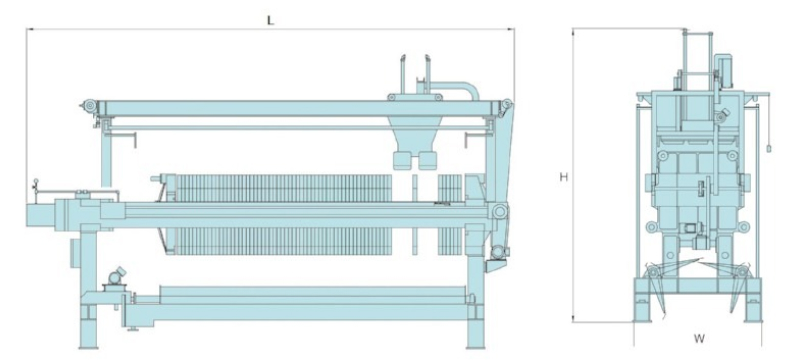
Even when the required filtration area is fixed, there is more than one way to configure a filter press to achieve it. The combination of filter plate size and plate quantity affects not only the equipment dimensions but also day-to-day operation and maintenance. Ultimately, practical constraints such as the installation location and equipment access route often determine the final configuration.
6.1 Selecting the Combination of Plate Size, Chamber Thickness, and Number of Plates
A given filtration area can be achieved through multiple equipment configurations.
For example, the same filtration area may be provided by:
- A smaller number of large filter plates, or
- A larger number of smaller filter plates
These alternatives differ in terms of overall machine length, footprint, and the weight of individual plates.
Larger filter plates typically offer greater processing capacity per plate, reducing the total number of plates required. However, they are heavier and can be more difficult to handle during maintenance and replacement.
When selecting a configuration, it is also important to consider the maintenance requirements associated with filter cloth and diaphragm sheet replacement. Ease of maintenance can be a significant factor in long-term operating satisfaction and should be evaluated alongside processing capacity.
Rather than focusing solely on throughput, it is beneficial to consider how the equipment will be operated and maintained on a daily basis throughout its service life.
▸ For details on filter press configurations and selection criteria, please refer to: Types of filter press
6.2 More Than Volume: Site-Specific Constraints
Equipment selection cannot be determined through capacity calculations alone.
Several site-specific factors must also be considered, including:
- Overall machine length when the plates are fully opened
- Clearance and height required for cake discharge
- Available installation space
- Access route width and ceiling height during equipment delivery
- Power supply and utility requirements for feed pumps and squeezing systems
In retrofit projects or installations within existing buildings, these practical constraints often define the maximum equipment size that can be accommodated.
6.3 Selection Checklist and Filtration Test Verification
The following information should be prepared before equipment selection:
- Required daily throughput
- Available operating hours
- Slurry solids concentration and characteristics
- Target cake moisture content
- Requirement for cake washing
- Available installation space
- Equipment access and transportation constraints
Providing this information at an early stage allows feasible equipment configurations to be evaluated efficiently and accurately.
7. Kanadevia's Approach to Filter Press Sizing
The previous sections have explained the general principles of filter press sizing. At Kanadevia, sizing is performed using filtration test equipment that shares the same structural design as the full-scale filter press. This allows test results to be directly translated into commercial equipment specifications.
7.1 Sizing Using Kanadevia's Test Equipment
Kanadevia conducts filtration tests using pilot-scale equipment that is structurally identical to the production-scale filter press.
The required filtration area is calculated based on the processing capacity per square meter of filtration area measured during testing and the customer's required daily throughput.
Because the test equipment uses the same filtration mechanism and construction as the full-scale machine, the test results can be directly applied to actual equipment design.
For standard plate size ranges, significant performance differences between test units and commercial equipment are generally not observed. However, depending on slurry characteristics, the design safety factor may be adjusted.
Filtration testing is conducted at the laboratory located within Kanadevia's Chikko Works in Japan, and customer witness testing can also be arranged.
7.2 Common Sizing Pitfalls and the Importance of Filtration Testing
One of the most common mistakes in filter press sizing is underestimating the filtration time.
Because filterability varies significantly depending on slurry characteristics, actual filtration times can be much longer than initially expected. When this occurs, the number of achievable cycles per day decreases, resulting in insufficient processing capacity.
In addition, when slurry properties vary due to seasonal changes or raw material fluctuations, sizing should be based on the most demanding operating conditions rather than average conditions.
Where cake washing is required, the washing step must also be included in the cycle time calculation.
These factors can all be evaluated more accurately through filtration testing using the actual process slurry.
8. Next Step: Consult Kanadevia
The accuracy of filter press sizing depends on matching two key elements:
- The required processing capacity
- The measured filtration characteristics of the slurry
Kanadevia offers a range of filtration testing services using pilot equipment with the same structure as production-scale filter presses. Tests are conducted at the laboratory within the Chikko Works in Japan, and customer attendance is welcome.
To facilitate efficient evaluation, please provide the following information when making an inquiry:
- Solids concentration
- Slurry or process liquid name
- Required filtration area (if known)
- Chamber thickness
- Application and process details
Next Step
■ 【For Customers Who Want to Verify Filtration Performance First】
Filtration testing can be performed using your actual slurry to evaluate filterability and dewatering performance.
Request For Filtration Test■ For Customers Seeking Technical Consultation.
Technical Inquiry■ 【For Customers with Established Specifications】
Quotation Inquiry■ 【For Customers Gathering Product Information】
Download the brochure for the Fully Automatic Compression Filter Press (TFAP) to learn more about the product structure and features.
Catalogue Download