
Lab Scale Filter Press: A Practical Guide to Validation Before Investing in Full-Scale Equipment
A lab scale filter press is a testing device that miniaturizes the same pressure filtration principles used in industrial filter presses. It is widely utilized for research and development, small-scale production, and pilot-scale testing. Its primary purpose is to generate the technical data required for full-scale equipment design, including cake moisture content, processing time, filter cloth selection, and wetted material compatibility when evaluating new slurries or upgrading existing processes.
This article explains the role and structure of lab scale filter presses, the performance data that can be obtained through testing, the scale-up process for industrial applications, how to choose the most appropriate testing approach, and common pitfalls that should be considered during evaluation.
To learn more about the product design and key features, download the product catalog for the Filter Press (TFAP Fully Automatic Compression Type):
1. Position and Role of the Lab Scale Filter Press
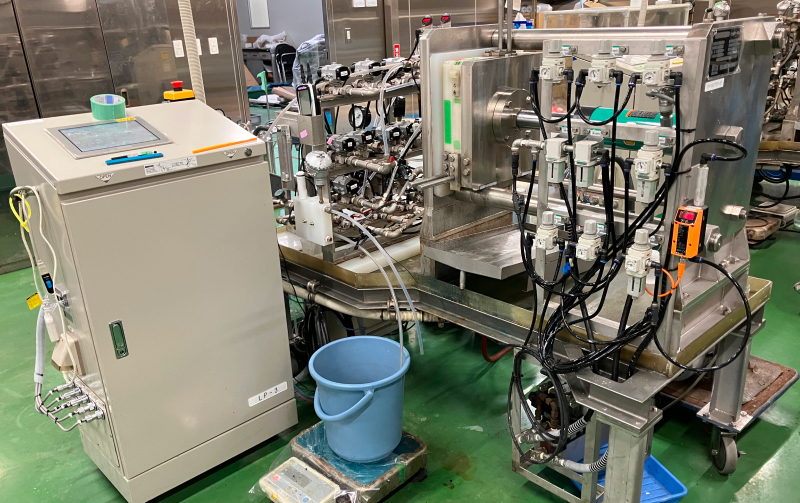
A lab scale filter press is used to experimentally evaluate the filtration and dewatering characteristics of specific slurries that cannot be accurately determined through theoretical design alone. The objective is to generate reliable performance data for selecting and designing full-scale industrial equipment. This section explains its relationship to industrial filter presses and where it fits within the decision-making process.
1.1 What Is a Lab Scale Filter Press? (Definition and Relationship to Industrial Equipment)
A lab scale filter press is a compact version of an industrial filter press that shares the same fundamental structure and operating principles. By using smaller plate sizes and fewer chambers, it allows representative cake formation behavior to be evaluated even when only limited sample volumes are available. As such, it serves as an essential step before selecting and investing in industrial-scale equipment.
1.2 Major Applications (R&D, Small-Scale Production, and Pilot Testing)
Lab scale filter presses are generally used for three primary purposes. In research and development, they are used to evaluate new slurries and assess the impact of flocculants or pretreatment conditions. In small-scale production, they provide solid-liquid separation for specialty products produced in limited quantities. In pilot testing, they are used to verify cake moisture content, throughput, and filter cloth selection before capital investment in full-scale equipment. These systems are widely utilized across industries including chemicals, pharmaceuticals, food processing, and wastewater treatment.
1.3 Progression from Bench Scale to Industrial Scale
Solid-liquid separation projects often progress through several stages:
- Bench scale (approximately 150 mm plate size)
- Lab scale (300–470 mm)
- Pilot scale (470–500 mm)
- Industrial scale (800–2,000 mm or larger)
As the available sample volume increases, the test equipment is progressively scaled up to better represent production conditions.
2. Basic Structure and Main Types
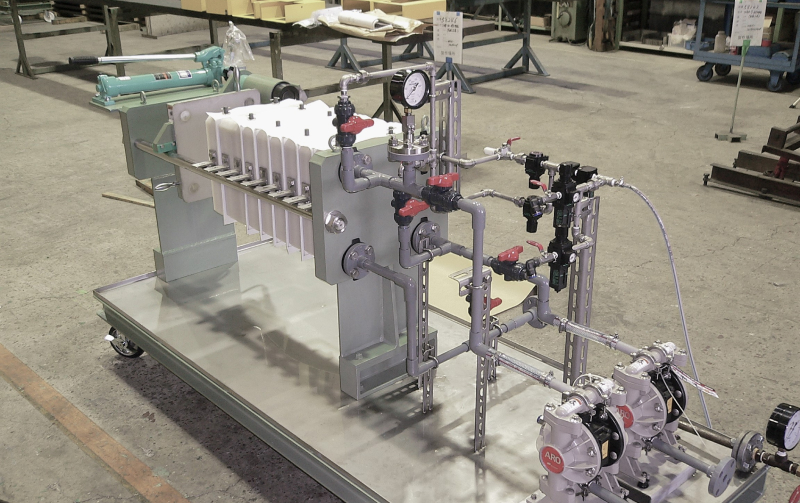
The basic structure of a lab filter press is equivalent to that of an industrial filter press and consists of a plate stack, filter cloths, a closing mechanism, a feed pump, and filtrate collection components. The primary differences between laboratory and industrial units are size and operational convenience.
2.1 Filter Press Types and Membrane Squeeze Options
Lab-scale filter presses are available in the same principal configurations as industrial systems, with an additional optional feature. Recessed Chamber Filter Presses create cake chambers through recessed filter plates and offer excellent versatility across many applications. Plate-and-Frame Filter Presses are particularly suitable for applications where cake washing is critical and high dewatering performance is required. Membrane Squeeze (Diaphragm) Systems can be added to chamber filter presses. During the final stage of filtration, an expandable membrane compresses the filter cake, further reducing moisture content.
▸ For more information on filter press configurations and selection criteria, refer to: Types of Filter Press
2.2 Key Design Variables (Plate Size, Filtration Area, and Chamber Thickness)
The primary specifications of a lab filter press are defined by four parameters: Plate size, Filtration area, Chamber thickness, Number of chambers. Typical laboratory units feature Plate sizes: 150–500 mm, Filtration areas: 0.01–0.5 m², Chamber thicknesses: 15–60 mm. Equipment sizing is generally determined by working backward from the required sample volume and desired cake thickness.
2.3 Automation Levels and Feed Systems
Lab filter presses are typically available in three automation levels:
- Manual hydraulic systems – the most common option for testing.
- Pneumatic systems – suitable for portable testing and applications without electrical power.
- Electric systems – capable of simulating automated operation similar to industrial installations.
Many units can reproduce the same plate closing pressure, feed pressure, and membrane squeeze pressure used in full-scale systems, improving scale-up reliability.
2.4 Wetted Materials and Chemical Compatibility
Polypropylene (PP) filter plates and rubber diaphragms (such as NR or EPDM) are the most common wetted materials used in laboratory equipment. Material selection depends on slurry characteristics such as pH, chloride concentration, and operating temperature.
When laboratory testing is intended to validate a metal-free wetted design for industrial equipment (PP and rubber construction), using the same wetted materials in both laboratory and full-scale systems improves the accuracy of corrosion and contamination assessments during scale-up.
3. Data Obtained Through Laboratory Testing
A lab scale filter press allows users to quantitatively evaluate slurry-specific filtration and dewatering characteristics before investing in production equipment. Six key parameters are typically evaluated: Cake moisture content, Throughput per unit time, Filtrate clarity, Filter cloth selection, Cake release characteristics, Cake washing performance. These findings provide the basis for determining filtration area, chamber count, wetted materials, and automation requirements.
3.1 Cake Moisture Content or Solids Concentration
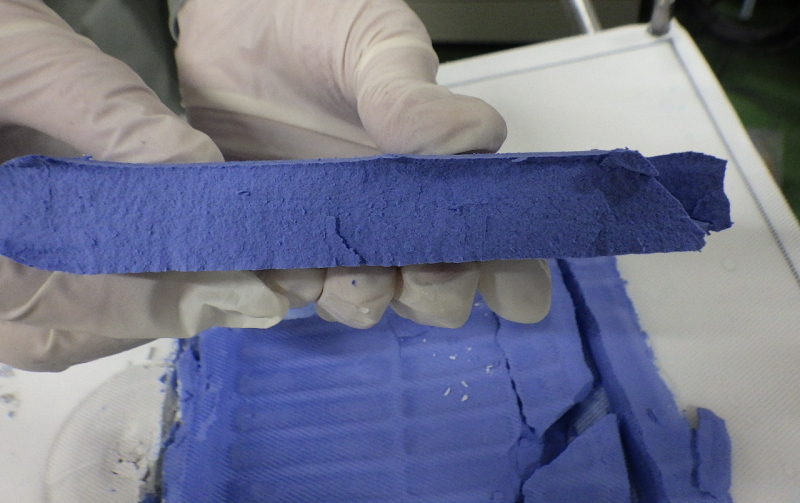
Cake moisture content (or solids concentration) is one of the most important performance indicators because it directly affects disposal costs, downstream processing requirements, and material handling characteristics.
Filter cakes produced under specified conditions of closing pressure, feed pressure, and operating time are sampled and dried to determine solids concentration. By varying membrane squeezing pressure and squeezing duration, users can evaluate whether target moisture levels can be achieved and whether additional features will be required in full-scale equipment.
3.2 Throughput and Cycle Time
The complete filtration cycle includes: Cake formation, Cake washing, Membrane squeezing, Cake discharge,
The total cycle time, filtrate volume, and solids mass processed per cycle are measured and used for scale-up calculations. Testing under multiple filtration pressures and cycle times helps determine optimal operating conditions.
3.3 Filtrate Clarity and Recovery Rate
Filtrate clarity depends largely on filter cloth performance and pretreatment conditions such as flocculant addition. Depending on the application, measurements may include: Suspended solids concentration, Residual contaminants, Color, Turbidity. For processes that recycle filtrate or recover valuable materials from the liquid phase, filtrate clarity and recovery efficiency become critical performance indicators. Comparative testing using multiple filter cloths is often conducted to identify the most suitable filtration media.
3.4 Filter Cloth Selection (Material and Weave Type)
Selecting the optimal filter cloth is often a primary testing objective. Evaluation parameters include: Material (polypropylene, polyester, etc.), Weave structure (monofilament, multifilament, spun fiber), Air permeability. Selection is based on balancing filtrate clarity, cake release performance, ease of maintenance, and durability. Long-term concerns such as filter cloth blinding and wear are also considered when selecting cloths for industrial operation.
3.5 Evaluation of Cake Release and Adhesion Characteristics
Cake release properties significantly affect equipment uptime and operating efficiency. Laboratory testing evaluates: Whether the cake naturally detaches from the cloth upon plate opening, Whether manual intervention is required, The degree of cake adhesion. For highly sticky cakes, discharge assistance systems such as scrapers may be necessary. Changes in flocculants or pH adjustment conditions are often evaluated to improve cake release characteristics.
3.6 Evaluation of Cake Washing Performance
Cake washing performance indicates how effectively residual impurities can be removed from the filter cake. Laboratory testing typically monitors the conductivity and pH of the wash water during washing. High conductivity at the beginning of washing gradually decreases as impurities are removed, allowing operators to quantitatively determine the wash water volume and washing time required to achieve target purity levels. This information is particularly valuable in applications where product purity and recovery efficiency are critical.
4. Scale-Up from Laboratory Testing to Industrial Equipment
Scale-up is the process of converting laboratory test results into the design parameters required for full-scale equipment.
Kanadevia utilizes test filter presses that share the same structural design and operating principles as industrial units. As a result, performance can generally be scaled up using straightforward calculations within the standard equipment range (plate sizes from approximately 300 mm up to 1,500 mm square) without significant performance deviation. However, depending on slurry characteristics, safety factors may still be necessary, and simple proportional calculations alone may not always capture all process variables.
4.1 Determining Industrial Equipment Size (Filtration Area, Cycle Time, and Batch Capacity)
The sizing of a production-scale filter press begins with the laboratory data obtained during testing, including: Cake thickness, Cycle time, Processing capacity achieved during testing. These values are converted into the required plant throughput (m³/day) to determine the necessary filtration area.
Once the required filtration area has been established, parameters such as the number of chambers, plate size, and degree of automation are considered to identify the most suitable equipment configuration. Selection is typically made by balancing installation footprint, capital investment, and operating costs. For membrane filter presses, which contain multiple operating phases such as primary filtration and membrane squeezing, specialized sizing methodologies are often applied.
▸ (For more information about industrial filter press construction and selection criteria, see our guide to Industrial Filter Press.)
4.2 Verifying Membrane Squeeze Performance and Selecting the Appropriate Equipment Configuration
When target cake moisture levels cannot be achieved through conventional chamber filtration alone, membrane squeeze testing can be performed using a laboratory unit equipped with membrane plates. By varying squeeze pressure and squeeze duration, the improvement in cake moisture reduction can be quantified. The results provide a clear basis for determining whether a standard recessed chamber filter press is sufficient or whether a membrane filter press should be selected. In many applications, membrane squeezing can simultaneously: Reduce final cake moisture content, Shorten overall cycle time, Increase throughput. Laboratory verification provides the technical evidence required to justify this equipment selection decision.
■ Performance data used for industrial equipment sizing can be obtained through testing with your actual slurry.
■ For questions regarding testing conditions, process suitability, or equipment selection:
Technical Inquiry5. Conduct Testing In-House or Use a Manufacturer’s Testing Facility?
Laboratory filtration testing can generally be carried out in one of three ways:
- Using an in-house laboratory filter press
- Utilizing a filtration testing service provided by an equipment manufacturer or engineering company
- Renting a laboratory filter press for temporary use
The most appropriate option depends on factors such as testing frequency, budget, slurry characteristics, available technical resources, and confidentiality requirements.
5.1 Owning an In-House Lab Scale Filter Press
Maintaining a laboratory filter press in-house offers several advantages.
First, it enables rapid data collection during research and development activities where frequent testing is required. Second, highly confidential slurry samples do not need to be transported outside the organization. Third, operating conditions can be adjusted freely, allowing extensive trial-and-error optimization.
On the other hand, in-house ownership requires an initial capital investment and ongoing maintenance costs. It also requires internal expertise in areas such as filter cloth selection, equipment operation, and scale-up analysis. For organizations that do not conduct filtration testing regularly, the return on investment may be limited.
5.2 Using Manufacturer-Provided Filtration Testing Services
Many filter press manufacturers offer laboratory filtration testing services using their own test facilities. One of the key advantages is access to the manufacturer's expertise from the earliest stages of process evaluation. Users can benefit from guidance regarding filter cloth selection, wetted material compatibility, automation options, and equipment sizing. In addition, the testing process can often be seamlessly connected to full-scale equipment selection and procurement. Some manufacturers also offer witnessed testing, allowing customers to observe the filtration process and evaluate results directly.
5.3 Comparison: In-House Equipment, Testing Services, and Rental Systems
Rental equipment allows users to conduct testing under multiple operating conditions within their own facilities while minimizing initial investment costs. Another advantage is that process samples do not need to be transported off-site.
Manufacturer-provided testing services offer the benefit of leveraging filtration expertise and receiving continuous support from testing through full-scale equipment selection.
Owning a laboratory filter press is most suitable for organizations that conduct research and development activities on a frequent basis.
Ultimately, the choice among in-house ownership, testing services, and rental equipment depends primarily on three factors: Testing frequency, Available budget, Confidentiality requirements related to the slurry and process. By evaluating these factors, users can select the testing approach that best supports their technical and business objectives.
6. Common Pitfalls to Avoid During Laboratory Testing
Laboratory filtration testing is a critical step in obtaining the technical data required to define equipment specifications. However, if test procedures or operating conditions are not properly designed, significant differences may arise between laboratory results and actual industrial performance.
This section outlines four common challenges encountered during laboratory filtration testing and provides practical considerations for minimizing scale-up risks.
6.1 Sample Representativeness and the Impact of Pretreatment
The reliability of laboratory test results depends heavily on whether the supplied sample accurately represents the actual process slurry. Slurry characteristics can vary significantly depending on factors such as solids concentration, temperature, and the elapsed time between sampling and testing. In addition, if flocculants, coagulants, or pH-adjusting chemicals are planned for use in the production process, the same pretreatment conditions should be applied during laboratory testing. Comparative testing under different pretreatment conditions can also be valuable for evaluating changes in cake formation, filtration performance, and dewatering characteristics.
6.2 Verifying the Release Characteristics of Sticky Filter Cakes
If a sticky filter cake is observed during laboratory testing, cake discharge can become even more difficult in a full-scale installation. Poor cake release may increase manual cleaning requirements during plate opening and reduce overall equipment availability. For this reason, cake release behavior should be carefully observed during laboratory testing. If significant adhesion is observed, additional cake discharge assistance mechanisms—such as scraper systems—may be required. Since complete cake release cannot always be guaranteed, early evaluation helps identify the need for mechanical discharge aids before equipment selection is finalized.
6.3 Compatibility of Wetted Materials with Corrosive Slurries
When testing acidic, alkaline, or chloride-containing slurries, the wetted materials used in the laboratory unit should match those planned for the industrial installation. Doing so is essential for accurately assessing potential corrosion issues and the risk of metallic contamination in production environments.
For example, if the industrial filter press is intended to employ a metal-free wetted design using polypropylene (PP) and elastomers such as NR or EPDM, the laboratory unit should use the same materials. If different materials are used during testing, the laboratory results may fail to accurately predict leakage, corrosion, maintenance requirements, or service life in the full-scale system.
6.4 Variables That Are Difficult to Replicate Between Laboratory and Industrial Scales
Certain process variables are inherently difficult to reproduce during laboratory testing. Typical examples include: Uniformity of slurry distribution during feeding, Long-term filter cloth wear and blinding, Interactions with upstream pretreatment processes during continuous operation, System response during shutdown and restart cycles on nights, weekends, or production interruptions.
For example, when a full-scale filter press incorporates a uniform feed distribution design such as a double top corner feed system, feed distribution is more likely to remain consistent throughout the filtration area. This can help minimize deviations in cake moisture content between laboratory results and industrial operation. Understanding these limitations during laboratory testing allows users to apply appropriate safety factors and engineering judgment during scale-up and equipment selection.
7. Next Step: Validate Your Slurry Through Laboratory Testing
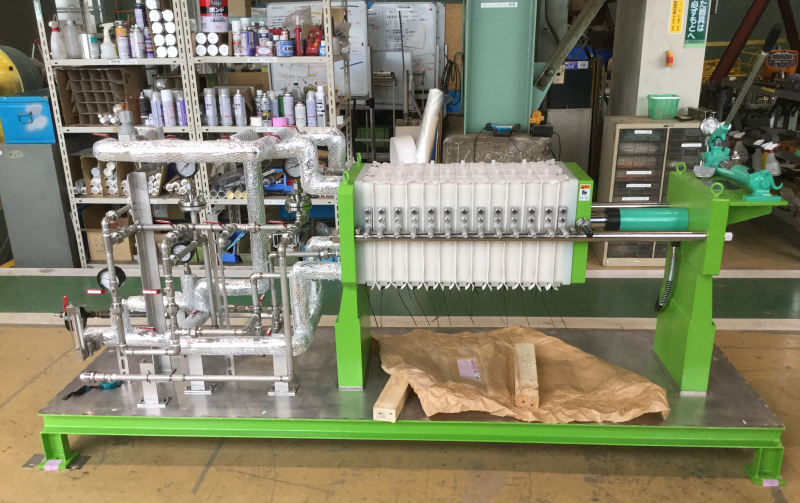
The primary purpose of a lab scale filter press is to generate slurry-specific filtration and dewatering data before investing in full-scale equipment. By obtaining reliable performance data in advance, users can reduce uncertainty during equipment specification and selection.
Whether evaluating a new slurry or considering the replacement of an existing filtration system, some process variables cannot be fully determined through theoretical calculations alone. Conducting laboratory testing provides objective data that can strengthen internal approvals, feasibility studies, and capital investment decisions.
7.1 Kanadevia's Filtration Testing Facilities and Witness Testing Process
Kanadevia operates four single-chamber filter presses (350 mm × 1 chamber) in the laboratory at its Chikko Works, where customers can evaluate the filtration characteristics of their own slurries. The test units provide: Filtration area: 0.117 m², Chamber thickness options: 25 mm, 30 mm, and 40 mm. These facilities can be used to verify: Cake moisture content, Processing time, Filtrate clarity, Optimum filter cloth selection, Wetted material compatibility.
Witness testing is also available, allowing customers to directly observe the testing process and utilize the results for internal evaluation and investment planning. The test equipment employs a metal-free wetted design using PP, NR, and EPDM materials, enabling compatibility assessments for corrosive slurries and helping predict full-scale operating performance.
7.2 Information to Prepare Before Requesting a Laboratory Filtration Test
To maximize the value of laboratory test results and ensure accurate equipment selection, relevant slurry information should be prepared before testing begins.
The information most commonly required can be summarized into the following five categories:
- Solids concentration
- Process liquid name, composition, and characteristics
- Target processing capacity and available operating hours per day
- Testing objectives (such as evaluating dewatering performance or cake washing performance; chamber thickness can be reviewed if a specific preference exists)
- Application (for example, wastewater dewatering or a production process)
Providing this information in advance allows test conditions to be designed more effectively and improves the quality and usefulness of the final test results.
▸ For a broader understanding of filtration principles and solid-liquid separation methods, please see the following guide: Liquid filtration.
Next Step
■ For customers who want to verify performance first:
Validate your slurry using test equipment designed to simulate industrial-scale filtration conditions.
Request For Filtration Test■ For consultation regarding test conditions or application suitability:
Technical Inquiry■ For customers with largely finalized specifications:
Quotation Inquiry■ For customers who would like to gather information first:
Download our product catalogue featuring the structure and key features of the Fully Automatic Compression Filter Press (TFAP):
Catalogue Download