
Wastewater Filter Press: A Practical Guide to Sludge Dewatering and Disposal Cost Reduction
A wastewater filter press is one of the primary mechanical methods for sludge dewatering, alongside belt filter presses and centrifuges. The U.S. Environmental Protection Agency (EPA) identifies the recessed chamber filter press as the dewatering technology capable of achieving the highest cake solids concentration among mechanical dewatering systems. This article explains the role of filter presses in wastewater treatment, key U.S. regulations, common application challenges, comparisons with alternative technologies, and major selection criteria.
To learn more about the product design and key features, download the product catalog for the Filter Press (TFAP Fully Automatic Compression Type):
1. The Role of Filter Presses in Wastewater Treatment and the U.S. Regulatory Environment
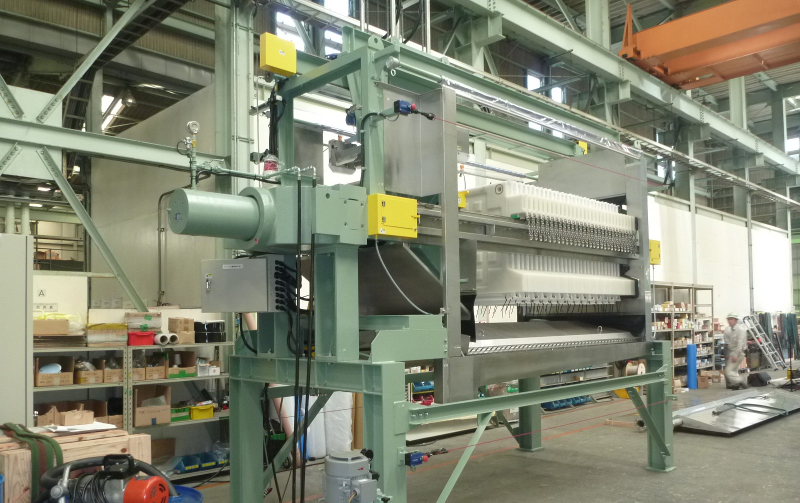
We will begin by examining the role of filter presses in the overall wastewater treatment workflow, followed by an overview of the key U.S. regulations relevant to wastewater treatment and sludge dewatering.
1.1 Solid-Liquid Separation and the Role of Sludge Dewatering Equipment
Wastewater treatment generally follows the process:
Pretreatment → Sedimentation → Biological Treatment → Sludge Treatment
Sludge generated during the treatment process must be dewatered to reduce disposal costs and improve handling efficiency. A filter press separates water from sludge through pressure filtration to form a filter cake. Its distinguishing features are batch operation and superior moisture reduction performance compared with belt presses and centrifuges.
1.2 Key U.S. Regulations
Wastewater and sludge treatment in the United States are subject to multiple federal regulations. 40 CFR Part 503 establishes standards for the use and disposal of sewage sludge, including pollutant limits and pathogen reduction requirements for Class A and Class B biosolids. 40 CFR Part 403 governs pretreatment programs and discharge limits for facilities that discharge to publicly owned treatment works (POTWs). The choice of dewatering technology is closely linked to the final disposal method—landfilling, incineration, or land application—and compliance with the associated regulations.
1.3 Basic Configurations of Wastewater Filter Presses
Wastewater filter presses generally fall into two categories:
- Recessed Chamber Filter Press: The most common type, offering straightforward operation.
- Plate-and-Frame Filter Press: Suitable for applications requiring precise cake washing.
For applications requiring even lower cake moisture content, a membrane squeeze system can be added. In this configuration, a membrane expands after filtration to further compress the cake and extract additional water.
▸ For a detailed explanation of filter press classifications and differences (See §1: Classification Criteria), please refer to our Types of filter press article.
2. Common Challenges by Application: Municipal and Low-Hazard Industrial Sludge
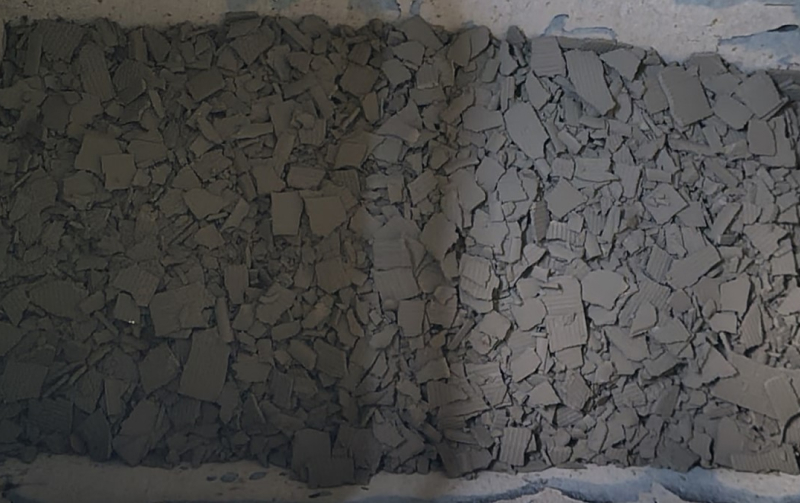
Typical wastewater filter press applications generally fall into two groups:
- Low-hazard sludge applications (municipal wastewater, food processing, pulp and paper, etc.)
- Metal-bearing and chemical industry applications (covered in Chapter 3)
For the applications discussed in this chapter, the primary economic benefit comes from reducing disposal costs through lower cake moisture content and reduced wet mass.
2.1 Municipal Wastewater Sludge (Biosolids)
Municipal sludge includes waste activated sludge and digested sludge. While many U.S. wastewater treatment plants adopt belt filter presses or centrifuges due to space limitations and continuous-operation requirements, filter presses can achieve significantly lower cake moisture content. Regulatory compliance requires 40 CFR Part 503 for land application and 40 CFR Part 258 for landfill disposal.
2.2 Food, Beverage, and Pharmaceutical Wastewater Sludge
Food and beverage facilities—including breweries, dairy plants, and fruit and vegetable processing plants—as well as some pharmaceutical manufacturing facilities, generate sludge with a high organic content. Filter presses are frequently selected for these applications because they can provide stable dewatering performance, high filtrate clarity, and reliable recovery of filtrate water for potential reuse in the production process.
For sanitary applications, filter presses may be equipped with stainless steel components, food-grade filter cloths, hygienic fittings, and non-toxic hydraulic oils.
2.3 Pulp, Paper, and Textile Wastewater
In pulp and paper mills, filter presses are used for fiber recovery and dewatering wastewater containing inks and coating materials. In textile manufacturing, dewatering systems must handle sludge generated from dyeing processes and withstand wide fluctuations in pH.
Because these industries typically require prolonged operation, filter cloth replacement labor and downtime become important operational considerations. In some cases, screw presses or belt presses may also be considered.
3. Common Challenges by Application: Metal and Chemical Industries
In metal-processing and chemical-industry wastewater treatment, key concerns include: Whether sludge qualifies as hazardous waste under RCRA regulations (especially F006 sludge) and Selection of appropriate wetted materials. These applications often realize particularly significant benefits from improved dewatering performance.
3.1 Electroplating, Surface Finishing, and F006 Metal Hydroxide Sludge
Electroplating and metal-finishing operations generate wastewater containing metals such as: Chromium, Nickel, Copper, Zinc.
After neutralization and precipitation, these contaminants are collected as metal hydroxide sludge. Under EPA regulations, such waste may be classified as F006 hazardous waste, resulting in substantial disposal costs. At the same time, the sludge may contain recoverable valuable metals.
Filter press dewatering can significantly reduce sludge volume, helping lower disposal costs while supporting resource recovery.
3.2 Corrosive Wastewater from Chemical Processes
Chemical plants often generate wastewater containing: Acids, Alkalis, Chlorides.
When metal wetted components are used, corrosion can cause: Leakage, Increased maintenance, Equipment shutdowns, Reduced service life.
Metal-free wetted designs, such as polypropylene plates with rubber diaphragms, provide improved chemical compatibility and can extend equipment life. Material compatibility is therefore an important selection KPI.
3.3 Oily Sludge and Mixed Industrial Wastewater
Refineries, automotive plants, and machining facilities frequently generate oily sludge following oil-water separation processes.
Depending on federal and state regulations, these wastes may require hazardous-waste handling. Proper sludge characterization and verification of compliance with NPDES permits and state regulations are essential.
Oil contamination can also degrade rubber components and cause filter cloth fouling. Therefore, it is generally advisable to remove oil as much as possible before dewatering equipment is used.
4. Comparing Wastewater Dewatering Technologies: Where Filter Presses Fit
Besides filter presses, the primary wastewater dewatering technologies include Belt filter presses, Centrifuges, Screw presses. This chapter identifies situations where filter presses offer advantages.
4.1 Comparison of Four Dewatering Technologies
As a general trend, filter presses can achieve a cake solids concentration of over 35%, depending on operating conditions. Belt presses typically achieve 18–35%, while centrifuges generally achieve around 20–30%, although performance varies with sludge characteristics. The table below summarizes the typical performance trends across the major evaluation criteria.
| Evaluation Factor | Filter Press | Belt Press | Centrifuge | Screw Press |
|---|---|---|---|---|
| Operation Mode | Batch | Continuous | Continuous | Continuous |
| Moisture Reduction | Excellent | Moderate | Moderate | Moderate to Low |
| Capital Cost | Moderate | Favorable | Moderate | Moderate |
| Footprint | Moderate | Large | Excellent | Small |
| Best Suited For | Low moisture content, high filtrate clarity | High flow rates | Limited space | Labor-saving, small-scale operations |
Filter presses are generally considered superior for moisture reduction, belt presses for lower initial investment and energy consumption, and centrifuges for compact installation requirements.
4.2 Why Moisture Content Directly Impacts Disposal Costs
The relationship between wet mass and moisture content is:
Wet Mass = Dry Solids ÷ (1 − Moisture Content/100)
Reducing moisture content from 85% to 70% can effectively cut wet mass by approximately half. Because landfill disposal fees in the United States are generally weight-based, improved dewatering directly reduces disposal costs and transportation costs.
The economic impact varies depending on whether the disposal method involves Non-hazardous landfill, Hazardous landfill, Incineration, Land application.
▸ For a broader comparison of liquid filtration and solid-liquid separation technologies, please refer to our article on Liquid filtration.
■ The best way to confirm achievable cake moisture content and material compatibility for your wastewater and sludge is through testing with actual samples.
■ For consultation regarding equipment selection and application suitability:
Technical Inquiry5. Selection Criteria and Minimum RFP Requirements
This chapter focuses on practical decision-making factors unique to wastewater sludge dewatering, including disposal methods, pretreatment compliance, and hazardous sludge handling.
5.1 Five Key Selection Variables
Filter press selection can be organized around five critical variables:
- Required cake solids concentration
- Wetted material compatibility (pH, chloride concentration, temperature)
- Automation level (manual, semi-automatic, automatic, fully automatic, and 24-hour operation requirements)
- Processing capacity (batch size and cycle frequency)
- Regulatory compliance (disposal method, pretreatment requirements, NPDES permits, hazardous sludge classification)
Defining priorities among these factors helps determine the optimal equipment specification.
5.2 Wastewater and Sludge Profile Checklist
Before evaluating equipment specifications, information should be collected regarding slurry characteristics (such as pH, chloride concentration, temperature, solids concentration, particle size, stickiness, and oil content), performance targets (including target cake moisture content, filtrate clarity, processing capacity, and cycle time), operating conditions (such as operating schedule, maintenance requirements, and available personnel), and regulatory requirements (including disposal methods, RCRA classification, NPDES permit conditions, and compliance with Parts 503 and 258).
5.3 Minimum RFP Requirements
The minimum information required for quotations and proposal development includes:
- Solids concentration
- Process fluid name
- Required filtration area
- Chamber thickness
- Application purpose (wastewater dewatering or production process)
Based on this information, manufacturers can recommend Number of chambers, Plate size, Automation scope, Wetted materials, Moisture reduction goals. Providing these details upfront improves quotation accuracy and streamlines subsequent testing and commissioning activities.
6. Common Pitfalls in Wastewater Applications and Design-Based Solutions
Three common operational challenges are Corrosion, Sticky cake discharge, Filter cloth replacement. Each directly affects uptime, moisture reduction performance, and filtrate quality.
6.1 Corrosive Wastewater and Metal Contamination
When acidic, alkaline, or chloride-containing wastewater is processed, corrosion of wetted materials can cause leakage, maintenance shutdowns, and eventual contamination of filtrate and cake through metal leaching.
Metal contamination is primarily a material-selection issue rather than a filter press type issue.
Metal-free wetted designs using polypropylene and rubber materials such as NR, EPDM, and PP provide improved chemical compatibility for:
- Chemical manufacturing
- Non-ferrous metals
- Battery materials
- F006 sludge applications
▸ For an overview of the corrosion-resistance and contamination-control benefits provided by wetted material selection, please refer to Advantages of filter press.
6.2 Poor Discharge of Sticky Cakes
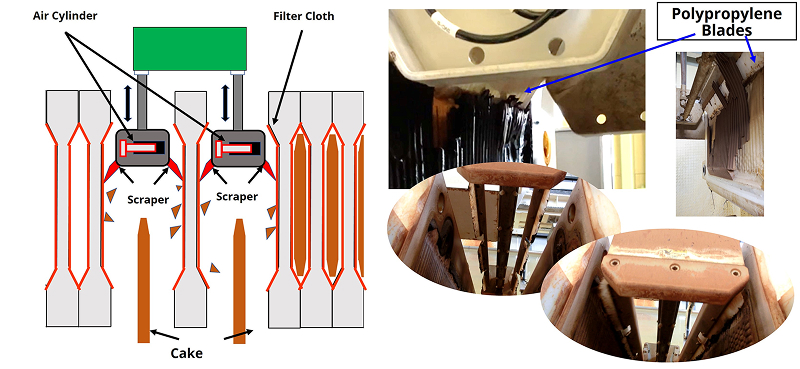
Industrial wastewater sludge often forms sticky cakes that do not separate cleanly from filter plates during discharge. This can increase manual labor and reduce operational efficiency.
Mechanical cake-discharge systems such as automated scrapers can improve cake removal consistency and support higher uptime.
6.3 Filter Cloth Replacement and Downtime
Filter cloths are consumable components that eventually require replacement due to wear, fouling, or damage.
Replacement time can significantly affect equipment availability.
Design features that simplify cloth replacement—such as top-mounted cloth systems secured with simple fasteners—can reduce maintenance burdens, particularly at facilities with limited maintenance staff.
When evaluating equipment, cloth replacement procedures and estimated replacement times should be included in the specification review process.
7. Next Step: Validate Performance Using Your Own Wastewater

Because sludge characteristics can vary significantly depending on facility conditions, season, and operating practices, equipment selection based solely on theoretical calculations is often insufficient.
Conducting a filtration test can significantly reduce uncertainty and minimize discrepancies between expected and actual moisture content or operational performance after installation.
This is particularly beneficial for:
- New projects
- Scale-up projects
- Existing equipment replacement programs
7.1 What Can Be Verified Through Filtration Testing?
Filtration testing can evaluate: Achievable cake moisture content, Processing speed, Filtrate clarity, Optimal filter cloth selection, Wetted material compatibility.
Testing is performed using pilot-scale equipment equivalent to actual operating conditions (350 mm × single chamber test units, Four parallel units, Filtration area: 0.117 m², Chamber thicknesses: 25 mm, 30 mm, and 40 mm. Witness testing is also available).
The results can provide valuable support for internal approvals and capital investment decisions.
When making an inquiry, please provide Solids concentration, Process liquid name, Required filtration area, Chamber thickness and Application purpose.
Next Step
■ For customers who want to verify performance first:
Confirm achievable cake moisture content and application suitability using your actual wastewater and sludge.
Request For Filtration Test■ For consultation regarding application suitability and specifications:
Technical Inquiry■ For customers with largely finalized specifications:
Quotation Inquiry■ For customers who would like to gather information first:
Download the catalog for the TFAP Fully Automatic Compression Filter Press to learn more about its design, features, and specifications.
Catalogue Download