
Liquid Filtration Selection Guide: From Clarification to Solid-Liquid Separation and Dewatering
Liquid filtration broadly covers the removal of solid particles, microorganisms, and colloids from a liquid stream. On the plant floor, however, the equipment you choose depends entirely on whether your goal is to ensure liquid clarity or to recover and dewater solid components. Mistaking these objectives often leads to severe equipment mismatches, directly impacting operating costs and processing quality.
This guide outlines the essential factors that equipment selectors should evaluate during the comparative stage. It breaks down liquid filtration into two primary systems—clarification and solid-liquid separation/dewatering—and concludes with the specific conditions where a filter press provides the optimal solution.
1. What is Liquid Filtration?
Liquid filtration is a separation process that passes a fluid through a filter medium (such as cloth, mesh, or membrane) to physically trap solid particles. Based on the processing objective, it is broadly divided into two categories: clarification and solid-liquid dewatering.
1.1 Basic Principles of Liquid Filtration: Medium-Based Solid-Liquid Separation
As filtration progresses, layer composed of captured solids (filter cake) typically forms on the filter medium. This layer itself functions as a secondary filtration layer. The system relies on gravity, pressure, vacuum, or centrifugal force as the driving mechanism and its filtration method is determined by the combination of the type of filter medium (surface filtration, depth filtration, or membrane filtration). As the cake builds up, flow resistance (differential pressure) increases; therefore, in practical operation, it is essential to design the cycle to include filter media replacement, backwashing, and cake discharge.
1.2 Clarification vs. Solid-Liquid Dewatering
Clarification targets low-solids fluids (from ppm levels up to a fraction of a percent) to remove fine particles down to the nanometer scale. The goal here is simple: maximize the purity of the liquid as your final product (like drinking water, process water, or purified chemicals). Solid-Liquid Dewatering, on the other hand, handles thick slurries (anywhere from a few percent to over 50% solids) to capture and dry the solid cake. The focus here is driving down cake moisture to slash disposal hauling costs or recover valuable materials (like sludge management, mining, or chemical manufacturing). Your selection always starts with one question: Is your product the liquid or the solid? Getting this wrong guarantees a costly equipment mismatch.
1.3 Initial Design Parameters: Concentration and Process Objectives
Before selecting a filtration method, it is essential to first understand the properties of the process liquid, including solids concentration, particle size distribution, viscosity, pH, temperature, and throughput. The key branching point is solids concentration. Generally, clarification filtration is the primary method for concentrations below less than 1%, whereas solid-liquid separation and dewatering is predominantly selected for concentrations exceeding 1% up to high levels. In the following sections, Chapter 2 explains clarification filtration, and Chapter 3 covers solid-liquid separation and dewatering, both using an identical structural framework: Configuration → Advantages → Operational Constraints → Suitable Conditions.
2. Main Clarification Filtration Methods
Clarification removes fine particles, microorganisms, and colloids from low-solids fluids to ensure final liquid purity. Here is a breakdown comparing the three primary methods used in the field: Bag Filters, Cartridge Filters, and Membrane Filters.
2.1 Bag Filter: High Flow, Low Cost, and Versatile
This system uses a filter bag seated inside a housing basket, trapping particles as the liquid flows through it. With micron ratings ranging from 1 to several hundred microns, it is built to handle high flow rates. Its biggest advantage is that it generates only about 1/10th to 1/15th the waste volume of a cartridge filter. On the downside, it isn't meant for high-precision microfiltration. High-viscosity liquids or sticky particles will plug the bags quickly. It is ideal for high-flow applications that require moderate particle removal while keeping waste to a minimum, such as chemical plant cooling water loops or paint lines.
2.2 Cartridge Filters: High Precision and Small Batches
This setup uses media molded into structured cartridges—such as pleated, melt-blown, or string-wound designs—slotted into a housing. They operate using either surface or depth filtration mechanisms. Cartridge filters provide high-precision filtration (ranging from 0.2 down to 10 microns) and are widely used where high purity is critical, such as in the pharmaceutical, semiconductor, and beverage industries. Keep in mind that the cost per square foot of filtration area is relatively high, making them a poor fit for high-solids fluids. They are ideal for low-solids, low-flow operations that demand strict particle control.
2.3 Membrane Filters: Step-by-Step Separation (MF / UF / NF / RO)
This method uses semi-permeable membranes and a pressure differential to separate particles, molecules, and ions on a microscopic level. Based on pore size, they are classified into four stages: Microfiltration (MF: 0.1 to 10 µm), Ultrafiltration (UF: 0.01 to 0.1 µm), Nanofiltration (NF: around 0.001 µm), and Reverse Osmosis (RO: under 0.001 µm). While they deliver unmatched liquid purity, managing membrane fouling requires careful system design, including upstream pre-treatment, cross-flow operation, and routine chemical cleaning cycles. They are chosen for high-spec applications like advanced drinking water treatment, biopharma concentration, and seawater desalination.
3. Main Solid-Liquid Dewatering Methods
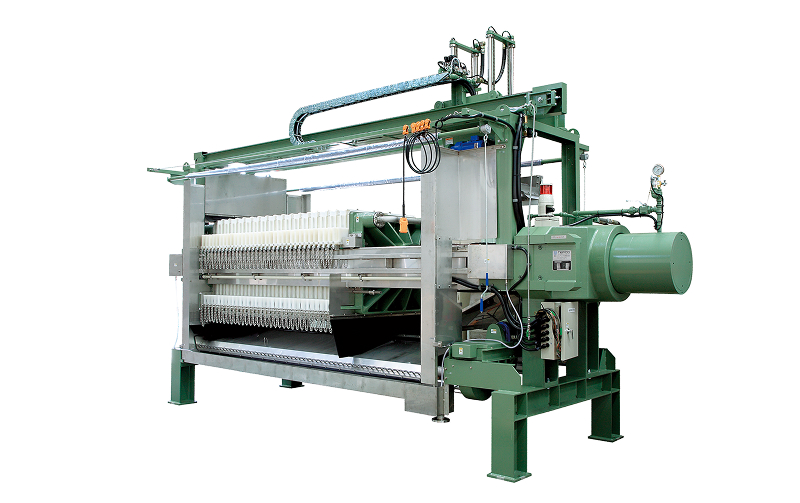
Solid-liquid dewatering processes high-solids slurries to capture and dry solid materials. The goal is to drive down cake moisture to slash disposal hauling costs or recover valuable products. The three primary options used in the field are Filter Presses, Belt Filters, and Centrifuges.
3.1 Filter Presses: Low Cake Moisture, Thorough Cake Washing, and High Corrosion Resistance
A filter press operates by feeding slurry under pressure between filter plates and filter cloths, discharging the filtrate while recovering the solids as a cake. This is a batch process that can typically drive final cake moisture down to a baseline of around 70%, with membrane squeeze configurations lowering that number even further. It easily integrates a cake washing function, making it highly effective for product recovery or impurity removal. The technology also features a wide selection of corrosion-resistant materials, such as polypropylene (PP) filter plates. However, its batch nature inherently limits throughput on high-volume continuous lines; therefore, overall plant uptime depends heavily on quick cloth replacement and easy cake discharge. This system is often the optimal choice for production lines that demand low cake moisture, intensive washing, and high corrosion resistance, such as the chemical, non-ferrous metal, and battery material sectors. For a deeper breakdown of specific configurations, please refer to our "Types of Filter Press" article.
3.2 Belt Filters: Continuous Processing for High-Volume Slurries
This system feeds slurry onto a moving filter belt, utilizing gravity drainage followed by roller pressing to achieve continuous dewatering. It enables continuous operation and high-throughput processing, which is highly suitable for large-volume applications including mine tailings. However, its final cake moisture content tends to be inferior to a filter press, generally averaging around 80% to 85% depending on operating conditions. Maintenance overhead for belt replacement and cleaning, along with odor control, are common challenges. This approach is best when continuous bulk processing and high throughput are prioritized over achieving the lowest possible moisture content. For more details, please refer to our "Vacuum Belt Filter" article.
3.3 Centrifuges: High-Speed and Compact Footprint
Decanter centrifuges utilize high-speed rotation to generate centrifugal force, separating solids and liquids based on density differences. They offer continuous processing within a compact footprint and excel at separating oils and greases. On the downside, final cake moisture is frequently inferior to a filter press (typically running around 75% to 80% depending on conditions), and power consumption is relatively high. They also tend to have lower recovery rates for fine particles under 10 microns, and impose operational limits on shear-sensitive materials like crystals or biomaterials. This method is best suited for high-speed, high-volume operations where floor space is limited.
When a Filter Press Is on the Shortlist
If high dewatering performance, cake washing, or corrosion resistance is among the process requirements, a filter press becomes a strong candidate. The selection process can be streamlined through product literature and technical consultation.
■ Product Catalog:
Review the structure and key features of candidate filter presses, such as uniform cake washing capability and corrosion-resistant design.
■ Technology Selection Consultation:
identify the most suitable filtration method based on your process objectives and slurry/liquid characteristics.
4. Equipment Selection: Decision Flow by Process Objective
You can narrow down your equipment options significantly by answering three basic questions: What do you want to remove or recover? What are your required particle size and cake moisture targets? What is your total throughput? The standard selection protocol is defined as follows:
If solids concentration is under 1%: Clarification systems (Section 2) are your primary options.
・Need high flow rates with a 1–100 µm micron rating? → Bag Filters
・Need high precision with a 0.2–10 µm micron rating? → Cartridge Filters
・Need to catch molecules or ions down to 0.1 µm or smaller? → Membrane Filters
If solids concentration is over 1%: Solid-liquid dewatering systems (Section 3) are your primary options.
・Need low cake moisture, thorough cake washing, or high corrosion resistance? → Filter Presses
・Prioritizing continuous bulk processing (throughput over minimum moisture)? → Belt Filters
・Handling shear-tolerant materials and need continuous processing in a tight space? → Centrifuges
5. Equipment Comparison Matrix
The following is a comparison of the four main methods, organized by key criteria that directly impact the selection process.
| Evaluation Criteria | Bag Filter | Cartridge Filter | Membrane Filter | Filter Press |
|---|---|---|---|---|
| Objective | High flow rate; removal of coarse to medium particles | Fine microfiltration | Molecular & ionic separation | Solids recovery & dewatering |
| Micron Rating (Est.) | 1 to several hundred µm | 0.2 - 10μm | 0.001 - 10μm | Dependent on Filter Cloth |
| Optimal Solids Content | ppm to a few % | Ppm to below 1% | Sub-ppm | Over 1% to Over 50% |
| Operation Type | Continuous | Continuous | Continuous | Batch |
| Key Challenges | Blinding / Plugging | Cost | Fouling | Discharge and cake washing |
Evaluate Candidate Filtration Technologies with Actual Data
Comparison charts show only general industry trends. Since actual performance with your process liquid can significantly influence the final technology selection, filtration testing is highly effective once the list of candidate technologies has been narrowed down.
■ Confirm the Filtration Technology Through a Filtration Test:
Evaluate solid-liquid separation performance, cake moisture content, and washability using your actual process slurry to determine the most suitable filtration method and equipment specification.
6. Common Pitfalls When Implementing a Filter Press
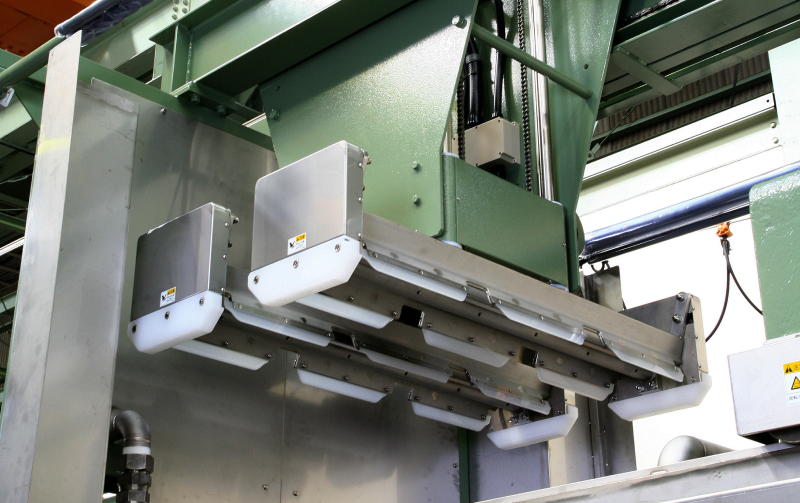
Even after you select a filter press, the following three recurring issues frequently impact plant uptime and product quality during the operational phase.
6.1 Cake Discharge (Poor Cake Release):Sticky cakes cause downtime and manual labor.
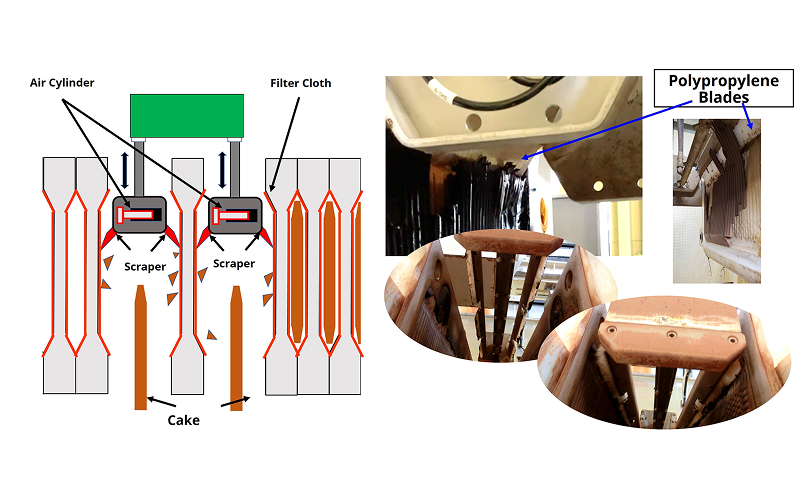
With sticky slurries, the filter cake often refuses to release from the cloth, forcing operators to remove it manually. This is an industry-wide challenge frequently highlighted in technical literature, as it directly hurts both plant uptime and operator safety. You can resolve this issue by upgrading your filter cloth material, installing mechanical scraper systems, or automating the cloth washing cycle.
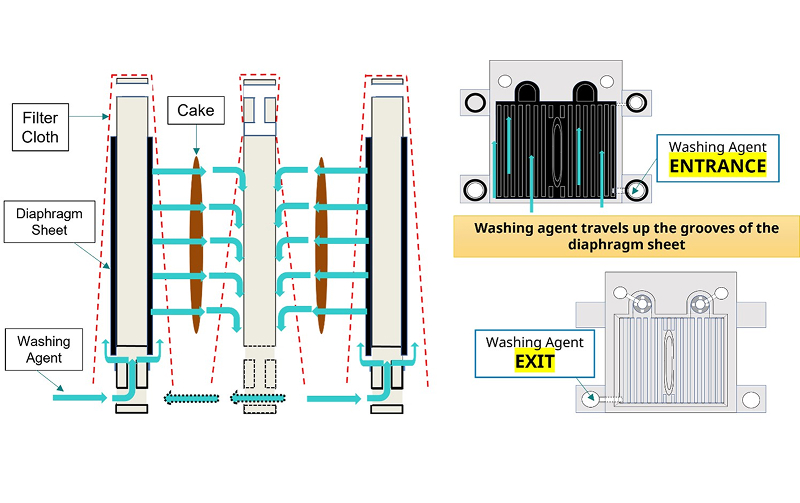
6.2 Cake Washing (Uneven Washing): Non-uniform washing directly impacts purity and recovery rates
Uneven cake washing leads to inconsistent product purity and causes you to lose valuable components in the process. This issue usually stems from how the slurry is distributed through the feed system. It can be corrected by using a corner-feed design for uniform distribution, optimizing wash fluid flow rates and cycle times, and selecting the right filter cloth. For applications where uniform washing is a key performance indicator (KPI), it is crucial to review the feed and distribution structure during the equipment selection phase.
6.3 Corrosion and Metal Contamination: Incorrect wetted materials create severe quality risks
Using metal for wetted parts introduces risks far beyond corrosion leaks and shortened equipment lifespan. It also creates a major quality hazard: metal contamination in your product can poison downstream catalysts, degrading their overall activity even at trace levels. By thoroughly reviewing your process fluid’s pH, chloride concentration, temperature, and exact chemical composition, you can determine whether to switch to a non-metallic wetted design, such as polypropylene (PP) paired with rubber materials.
7. Ideal Conditions for Filter Presses: Kanadevia’s Design Philosophy
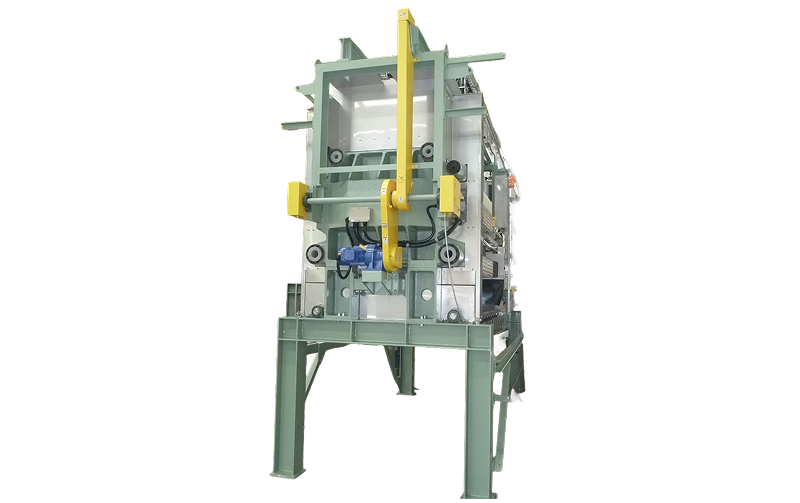
Among the various solid-liquid dewatering methods, a filter press is often the optimal choice for applications where three core requirements overlap: low cake moisture, thorough cake washing, and high corrosion resistance. Kanadevia filter presses are engineered around these three requirements, while also adding a fourth critical pillar—ease of maintenance. This four-axis design philosophy ensures our systems successfully eliminate the common pitfalls of real-world plant operations.
| Metal-Free Wetted Design (Polypropylene & Rubber Components) Engineered to eliminate metallic contamination and minimize leaks or maintenance shutdowns caused by corrosive slurries. This combination of polypropylene and rubber delivers dependable corrosion resistance in demanding acidic, chloride-based operations. |
Double Top-Corner Feed Optimizes slurry distribution to eliminate variances in filtration, dewatering, and cake washing. This delivers superior performance in applications where washing uniformity dictates product quality. |
| Mechanical Scraper Discharge Ensures consistent, automated cake release even with highly adhesive slurries. This mechanism minimizes manual labor, boosting both plant uptime and workplace safety. |
Drape-Over Cloth Replacement Features a drape-over cloth design that makes changeouts fast and simple. By significantly cutting down on labor hours and equipment downtime, this design relieves pressure on limited on-site maintenance personnel. |
For new slurries or projects still in the pre-finalization phase, we provide filtration testing services at our Chikko Plant laboratory. The lab setup utilizes a 350 mm single-chamber testing unit with a filtration area of 0.117 m² and selectable chamber thicknesses of 25, 30, or 40 mm. By verifying throughput capacity, target cake dryness, and the optimal filter cloth through precise test data, you can significantly increase the accuracy of your investment decisions.
8. Next Step: Consult with Kanadevia
Choosing the right liquid filtration method depends entirely on your specific process objectives, fluid properties, and required throughput. Focused on our core filter press technology, Kanadevia provides end-to-end support for solid-liquid dewatering—spanning everything from system design and filtration testing to ongoing maintenance. Depending on your current planning stage, please choose from the following three entry points to get started.
Next Step
■ If Specifications are Unconfirmed:
■ If Specifications are Finalized:
■ If in the Early Planning Stages:
For a more tailored proposal, please provide the following 5 parameters when contacting us: (1) Slurry/Fluid Name, (2) Solid Concentration, (3) Intended Application, (4) Required Filtration Area, and (5) Chamber Thickness.