
TYPES OF FILTER PRESS: KEY DIFFERENCES AND SELECTION GUIDE
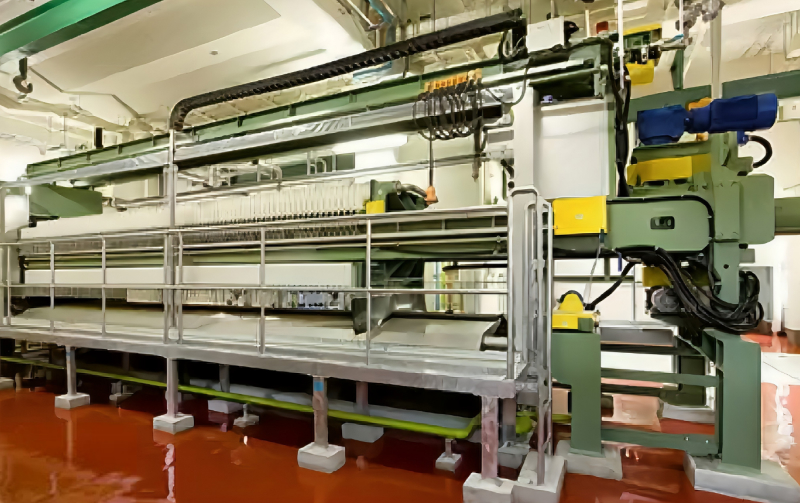
We have summarized the key differences and selection criteria—covering cake moisture content, cake washing efficiency, leakage control, automation, and maintenance requirements—to provide a clear framework for your evaluation. We’ve also explained the information needed to proceed with formal quotations and filtration testing.
Note: Actual performance and applicability vary significantly on slurry characteristics, operating conditions, and filter cloth selection. The comparisons presented here represent general tendencies.
1. UNDERSTANDING THE "TYPES OF FILTER PRESS"? KEY DIFFERENTIATION FACTORS
To understand the differences between filter press types, it is best to view them through four primary factors: (1) Plate configuration (how the filter chambers are formed), (2) Presence of additional squeezing, (3) Design for discharge, washing, and leakage control, and (4) Scope of automation.
1.1 THE FOUR MAIN CLASSIFICATIONS: THREE PLATE CONFIGURATIONS + AUTOMATION SCOPE
When selecting a system, the three plate configurations—Plate and Frame, Recessed Chamber, and Membrane Squeeze—are evaluated in conjunction with the "automation scope" (the extent to which manual tasks are mechanized).
In this context, "automatic" does not refer to a distinct filtration method. Instead, it defines the degree of operational task replacement—how many steps previously performed by hand are integrated into the automated control sequence. This includes processes such as plate opening/shifting, cake discharge assistance, filter cloth washing, and pressure/valve control with anomaly monitoring (via PLC/HMI) (detailed in Section 5).
1.2 DISTINGUISHING EQUIPMENT TYPES FROM FILTER PLATE CONFIGURATIONS
One common oversight is confusing the general equipment type with the specific filter plate configuration. While they are related, the plate's design—such as whether the plate is recessed or membrane-equipped, and whether it is gasketed (CGR) or non-gasketed (NG)—directly impacts the approach to leakage control, washing efficiency, and maintenance.
2. CHARACTERISTICS OF THE PLATE AND FRAME TYPE
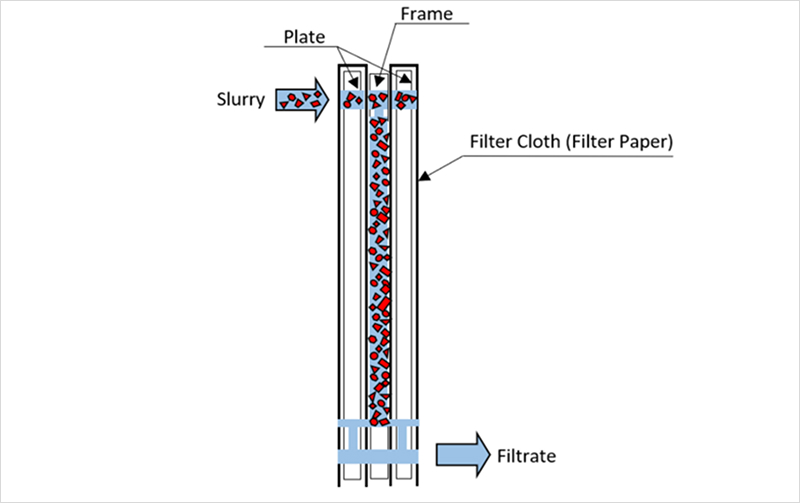
This is a basic design where plates and frames are layered alternately, with the frame forming the cake chamber (thickness). This type offers great flexibility in washing and filter media (cloth) selection and allows you to use paper media. However, if your main goals are high throughput and reduced labor, we typically recommend starting your evaluation with the Recessed Chamber type instead.
2.1 STRUCTURE: THE FRAME DEFINES THE CAKE VOLUME
It is easiest to understand this type by viewing the frame thickness as the cake thickness. This construction is often adopted for small-to-medium scale applications or in scenarios where testing requires adjusting the cake thickness to optimize filtration conditions.
2.2 PROS & CONS: FLEXIBILITY VS. AUTOMATION AND THROUGHPUT
Best suited for: Cases prioritizing high design flexibility for the washing process or situations where the filter media (cloth) must be changed frequently to fine-tune operating conditions. Less suited for: Scenarios requiring consistently high throughput or labor-saving automation for plate opening. In these cases, comparing this type alongside the Recessed Chamber (Chamber Type) will help clarify the best approach.
2.3 NOTE: CONSISTENT EVALUATION CRITERIA REGARDLESS OF TERMINOLOGY
Regardless of the specific technical terms used in your search, the core of any evaluation usually comes down to two things: the structural differences of the filter press as a solid-liquid separation device and the resulting operational trade-offs.
3. CHARACTERISTICS OF THE RECESSED CHAMBER TYPE
The Recessed Chamber type forms a filtration chamber by joining two recessed plates together. Widely used across industries for both sludge and process slurries, this versatile type serves as a foundation that can be enhanced with membrane squeezing or automation based on your operational goals.
3.1 STRUCTURE: FORMING CHAMBERS VIA PLATE RECESSES
Slurry is supplied under pressure through the feed port, and the filtrate is discharged through channels within the plates. The design typically involves discharging the accumulated cake after the plates are opened.
3.2 LEAKAGE CONTROL: GASKETED (CGR) VS. NON-GASKETED (NG)
Gasketed (CGR: Caulked, Gasketed, and Recessed): Effectively minimizes leaks and drips, but requires additional maintenance time for periodic gasket inspection and replacement.
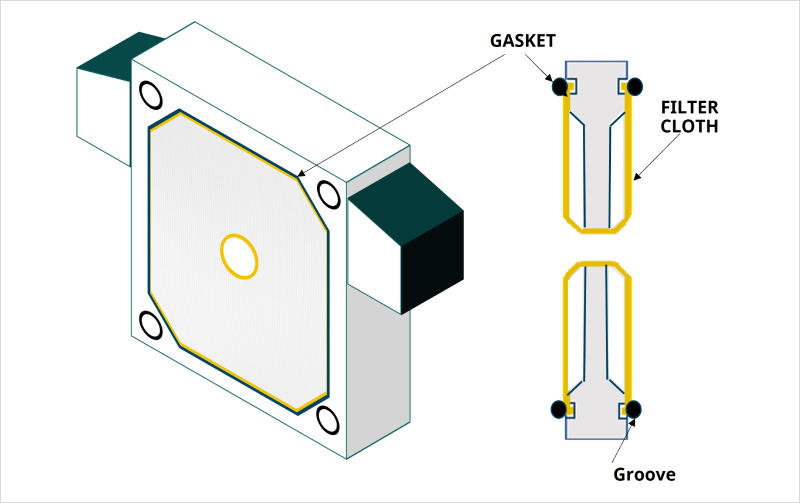
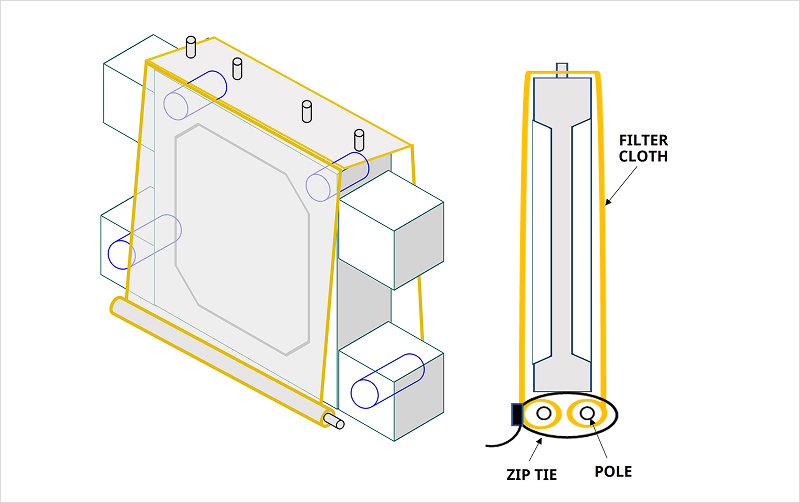
Non-Gasketed (NG): Features a simpler structure that is easier to handle. However, since it is more sensitive to clamping conditions and the state of the filter cloth, it requires carefully defined operational settings and maintenance standards.
3.3 APPLICATION EXAMPLES: SLUDGE DEWATERING AND INDUSTRIAL PROCESS APPLICATIONS
Environmental & Wastewater Applications: The primary focus typically centers on minimizing disposal costs and ensuring operational stability.
Industrial Production Applications (Chemicals, Pigments, Non-ferrous Metals, etc.): These processes are characterized by clearly defined Key Performance Indicators (KPIs), such as cake washing uniformity, purity levels, and overall recovery yields.
4. CHARACTERISTICS OF THE MEMBRANE SQUEEZE TYPE (ADDITIONAL SQUEEZING)
The Membrane Squeeze type utilizes a diaphragm to apply additional pressure to the filter cake after filtration, aiming for lower moisture content (drier cake). This type is frequently evaluated in scenarios where high disposal fees, substantial drying costs, or stringent moisture requirements make the initial investment highly cost-effective.
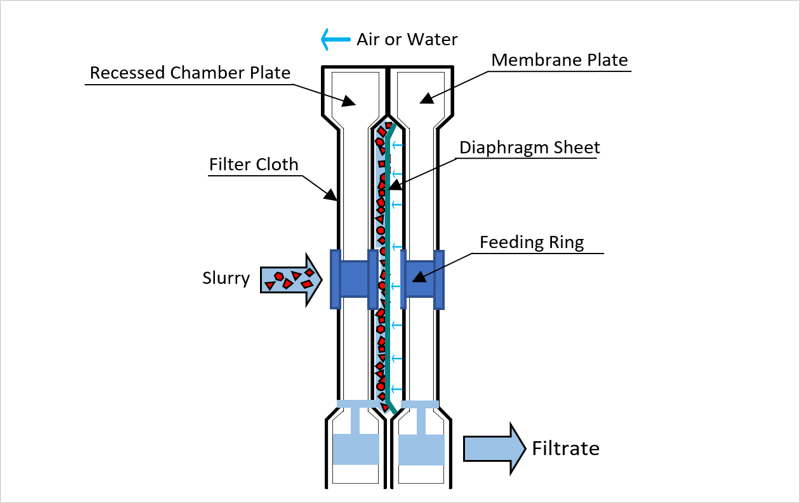
4.1 THE MECHANISM: WHY IT ACHIEVES LOWER MOISTURE CONTENT
The core mechanism involves applying mechanical pressure to the pre-formed cake to force out remaining interstitial water. Since the effectiveness depends on the specific slurry characteristics and squeezing conditions, conducting a filtration test is the most reliable way to confirm results.
4.2 KEY DRIVERS: DISPOSAL COSTS, DRYING EXPENSES, REGULATIONS and PROCESS TIME
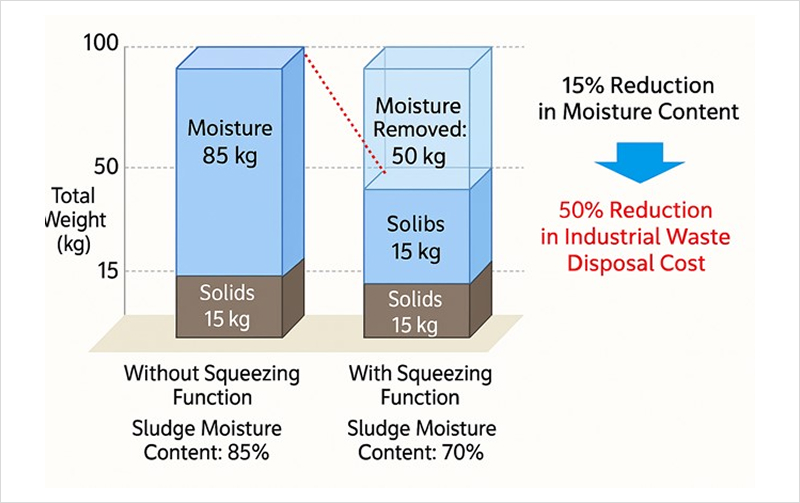
In applications where disposal is charged by wet weight (e.g., wet tons), where drying is the bottleneck process, or where downstream process impose strict moisture limits, even a small reduction in moisture content can significantly impact annual operating costs.
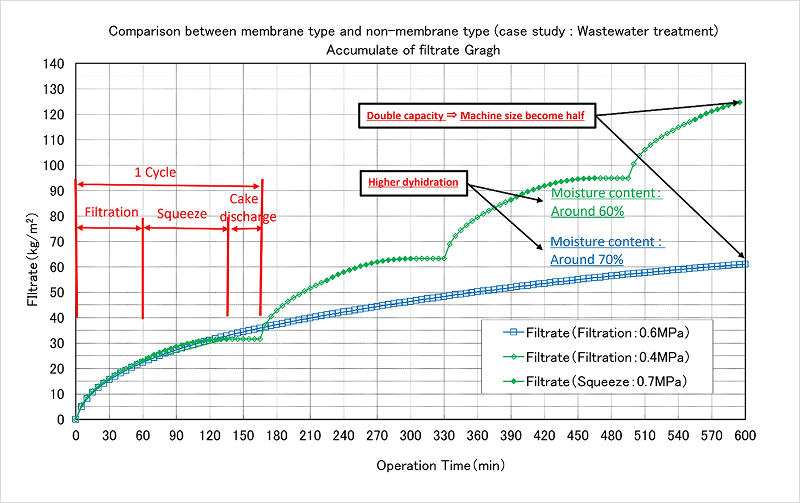
And also the Membrane Squeeze type has another significant advantage regarding to process time. Non-membrane filter presses rely solely on pump pressure to perform the filtration process. As the filter cake builds up, the resistance increases causing lengthening of filtration time.
In contrast, Squeez filter press is designed for higher operational efficiency. Once the fiow rate start to decline, the system automatically stops filtration and initiates the squeezing process. This diaphragm-based squeezing significantly reduces cycle time and improves throughput.The graph below shows the effiicacy of the membrane filter plate compared to non-membrane type.
Membrane type filter presses are more effective at reducing the moisture content of the filter cake compared to non-membrane types. This makes them ideal for industries that require faster processing and drier cakes, such as chemical manufacturing, mining, and wastewater treatment.
5. HOW TO INTERPRET “AUTOMATION”
"Automation" is not a filter press type; rather, it is a design decision defining the extent to which operational tasks are mechanized and controlled. Even within the same Recessed Chamber configuration, the chosen scope of automation will significantly impact labor requirements, safety, and overall equipment effectiveness (OEE).
5.1 COMPONENTS OF AUTOMATION: PLATE SHIFTING, CAKE DISCHARGE, CLOTH WASHING, AND CONTROL
Key elements of automation include: (1) Automatic plate opening and shifting, (2) Discharge assistance (vibration, scrapers, etc.), (3) Automatic cloth washing, and (4) System monitoring and control (via PLC/HMI for pressure, valves, and anomaly detection). The selection of these elements should be based on identifying which manual tasks are currently the operational bottlenecks.
5.2 WHEN AUTOMATION DELIVERS THE MOST VALUE: FREQUENCY, LABOR, SAFETY, AND REPEATABILITY
The investment value of automation increases in scenarios involving 24/7 or high-frequency operation, labor shortages, or stringent safety requirements. Beyond simple labor reduction, automation should be evaluated for its ability to minimize downtime and maximize uptime.
5.3 COMBINING CONFIGURATIONS AND AUTOMATION
Ultimately, the final solution is defined by the strategic pairing of the plate configuration with the right level of automation. For example, a Recessed Chamber type combined with Membrane Squeeze and Automation offers a distinct performance profile. When evaluating your options, it is helpful to look at the combination of these distinct components: (1) Plate type, (2) Discharge and washing design, and (3) Scope of automation.
6. NAVIGATING OTHER "TYPES": VERTICAL, HIGH-PRESSURE, AND MATERIALS
Terms like "Vertical," "High-Pressure," "Round Plate," or "Materials" (e.g., PP, Stainless Steel) are often referred to as equipment "types," but in most cases, these are specifications rather than fundamental filtration methods. The standard engineering approach is to first select the core filtration method and then layer on the necessary specifications.
6.1 POSITIONING OF VERTICAL FILTER PRESSES
Vertical filter presses are a distinct category, typically considered for space-saving requirements or specialized dewatering processes. However, they all suffer from the disadvantages of high cost, limited filter area, and mechanical complexity. Since the design principles of vertical units differ from horizontal units, they should be evaluated as a separate comparison based on your specific process needs.
6.2 MATERIALS AND HIGH-PRESSURE: METHODOLOGY VS. SPECIFICATION
In processes sensitive to corrosion or metallic contamination, selecting the appropriate wetted materials is a critical factor. Material choices and leakage control should be evaluated alongside the plate type.
7. COMPARISON TABLE: PERFORMANCE, OPERATION, AND COST
Organizing major types against a consistent set of evaluation criteria creates a common language for internal reporting and the development of RFPs (Requests for Proposal). While this table serves as a helpful guide for your project’s direction, final decisions should be validated by actual slurry test data.
7.1 Comparison Factors: Dryness / Washing / Leakage / Automation / Maintenance / Cost
| Equipment Type | Cake Dryness | Washing Efficiency | Leakage Control | Automation Level | Maintenance Demand | Investment Level |
|---|---|---|---|---|---|---|
| Plate & Frame | Medium | High | Medium | Limited | Medium | Medium |
| Recessed Chamber | Medium | Medium〜High | Medium | High | Medium | Medium |
| Membrane Squeeze | High | Medium〜High | Medium | High | Medium〜High | High |
| Automation Scope | — | — | — | High | Low〜Medium | Medium〜High |
Note: Since automation refers to the operational scope rather than the filtration method, performance factors such as dryness, washing, and leakage are determined by the base plate type.
7.2 APPLICATION-SPECIFIC RECOMMENDATIONS
- Wastewater and Sludge Dewatering: The Recessed Chamber type is typically the starting point. From there, evaluate the addition of Membrane Squeezing (to reduce moisture content) and Automation (to address labor and safety concerns) based on your specific needs.
- Mining and Minerals: Large-scale processing and heavy-duty equipment are dominant. Therefore, the size range, installation conditions, and the scope of automation tend to be the primary points of discussion (individual performance often depends on custom specifications).
- Chemicals, Pigments, and Non-Ferrous Metals (including Rare Metals): Uniform washing (for purity and recovery), corrosion resistance, and the avoidance of metallic contamination are key KPIs. Comparison should focus on the distribution design for slurry feeding/washing and the selection of wetted materials.
8. SELECTION GUIDE: A CHECKLIST TO TURN "COMPARISONS" INTO "YOUR SPECS"
Now that you’ve got a handle on the different types, the next question is: "What do I actually need to decide for my own site?"
To help with that, try to pull the following items together on a single sheet (and don’t worry—if you’re not sure about something, just mark it as TBD). This is the minimum dataset that you can simply copy and paste right into an inquiry form for a quotation or a filtration test.
- Application & Process: Is it for production (recovery/purity) or wastewater (disposal costs)? Which is the main goal: the cake or the filtrate?
- Throughput & Operation: Capacity in m3/h, operating hours, maximum cycle time, and number of cycles per day.
- Target KPIs: Target moisture content, filtrate clarity, and whether washing is needed (and for what: purity or recovery?).
Solids Concentration : Average percentage and the typical range of fluctuation (%).- Particle Size & Compressibility: Estimated particle size (D50, mesh size, etc.) and whether the cake is compressible.
- Adhesion & Release Properties: Does the cake tend to stick to the cloth or be difficult to discharge?
- Corrosion & Metallic Contamination: pH levels, chloride (Cl-) concentration, and temperature. Is metallic contamination allowed?
- Washing Conditions: Type of wash water or chemicals, flow/pressure constraints, and quality standards after washing.
- Site Constraints: Installation footprint, delivery routes, utilities (power/water/drainage), and EHS (Environment, Health, and Safety, e.g., explosion-proofing).
- Setting Your Priority: Since it’s often a balancing act, what’s your #1 goal? Is it "Dryness First," "Washing First," or "Labor Savings First"?
Once you have these 10 items settled, the right path forward starts to show itself: Dryness points us toward Membrane Squeezing, Washing leads to Distribution Design, Labor defines our Automation Scope, and Corrosion tells us which Wetted Materials to pick. In Section 9, we’ll look at those annoying pitfalls that can pop up after installation, like discharge issues or uneven washing.
8.1 SLURRY CHARACTERISTICS: PARTICLE SIZE, ADHESION, SOLIDS, AND CORROSION (PH/CL-)
Slurry properties directly impact filtration speed, clogging, discharge efficiency, and material selection. In particular, corrosive properties (pH, chlorides, temperature) and cake adhesion (how easily it releases) are extremely important when deciding on a design.
- The Essentials (Needed for an initial proposal): Solids concentration (%), temperature, pH, chlorides (if known), estimated particle size, and your general sense of its adhesion (how sticky or hard to drop it is).
- Helpful for Better Accuracy: Particle size distribution, specific gravity, viscosity, compressibility, abrasiveness, filtrate composition, and the MSDS (Material Safety Data Sheet).
- Sample Availability: How much sample can you provide for testing? What are the storage requirements? Are there any hazardous materials? *Please note: We may not be able to test liquids classified as hazardous materials.
8.2 TARGET KPIS: CAKE MOISTURE/ FILTRATE QUALITY / WASHING RECOVERY / THROUGHPUT / CYCLE TIME
Putting your Target KPIs into words is the fastest way to see which design or options you actually need. It’s a helpful shortcut to first align internally on the deciding factor: Dryness (Moisture), Filtrate Quality, Washing (Purity/Recovery), or Throughput & Cycle Time.
- Dryness (Moisture Content): Example: "We want the cake moisture below XX%." → This puts Membrane Squeezing at the top of the priority list.
- Cake Washing (Purity / Recovery): Example: "We need to wash out impurities" or "We want to recover valuable materials from the residue." → This makes Washing Distribution and Uneven Washing Prevention the key focus.
- Filtrate Quality: Example: "Filtrate SS must be below XX mg/L." → Filter Cloth Selection and Operating Conditions become the main drivers here.
- Throughput & Cycle Time: Example: "Required capacity is XX m3/h" or "Cycle time must be under XX minutes." → This dictates the Filtration Area and the Scope of Automation.
8.3 ECONOMICS: DISPOSAL COSTS / DRYING COSTS / LABOR (ROI)
When evaluating economics, it’s essential to look beyond the CAPEX (equipment cost) and consider the OPEX (disposal, energy, and labor). Since Cake Dryness directly impacts disposal fees and drying energy, showing a clear improvement here makes it much easier to justify the ROI for Membrane Squeezing.
- Disposal Costs: If you’re charged by wet weight, even a small difference of 1% to a few percent in moisture content can have a massive impact on your annual bottom line.
- Drying Process: If drying is your bottleneck, strengthening the dewatering stage beforehand is a highly effective way to boost overall plant efficiency.
- Labor & Downtime Losses: When evaluating automation, don’t just look at headcount reduction—it’s often easier to see the value when you calculate it as "reduced downtime" and "higher machine availability."
8.4 SITE CONSTRAINTS: FOOTPRINT / UTILITIES / SAFETY REQUIREMENTS
Site constraints often dictate a project's feasibility well before technical specifications are finalized. To avoid costly redesigns, it is critical to identify requirements for space, logistics, power, wash water, drainage, ventilation, and EHS standards—including explosion-proofing—at the very beginning to prevent costly mid-project redesigns.
- For Small to Mid-Sized Projects with Tight Timelines: Consider an all-in-one package (e.g., AUTOPAC(PRO)) that integrates the control panel and hydraulic unit. This is often the fastest route to getting up and running.
- Maintenance Structure: Can you handle nighttime responses? Where will spare parts be stored? And importantly, who will handle the filter cloth washing, and how often?
- Wash Water & Chemical Supply: Are there constraints on flow rate, pressure, or wastewater treatment—either on the equipment side or from your plant’s operations?
- Delivery Route & Methods: Can the unit fit through your existing access points? Do we need to deliver the unit disassembled and reassemble it on-site due to narrow access points?
- Electrical Specifications: Confirm voltage, frequency, capacity, and the SCCR (Short Circuit Current Rating) to ensure compatibility with your power grid.
9. COMMON PITFALLS AND COUNTERMEASURES
The biggest performance gap after installation usually appear in Cake Discharge, Cake Washing, and Corrosion/Metallic Contamination. Especially in North American projects, the design of washing and discharge (release) efficiency is often a major evaluation factor. It’s best to review these alongside your equipment selection.
9.1 "STICKY CAKE" ISSUES: DISCHARGE MECHANISMS AND ADHESION CONTROL
Sticky cakes are a frequent cause of manual intervention and unplanned downtime. A practical approach is to organize your strategy into two steps: (1) Optimizing filter cloth and operating conditions, and (2) Evaluating discharge assistance (vibration, scrapers, etc.). Don't just assume gravity will do the work—whenever possible, confirm the actual discharge performance through testing.
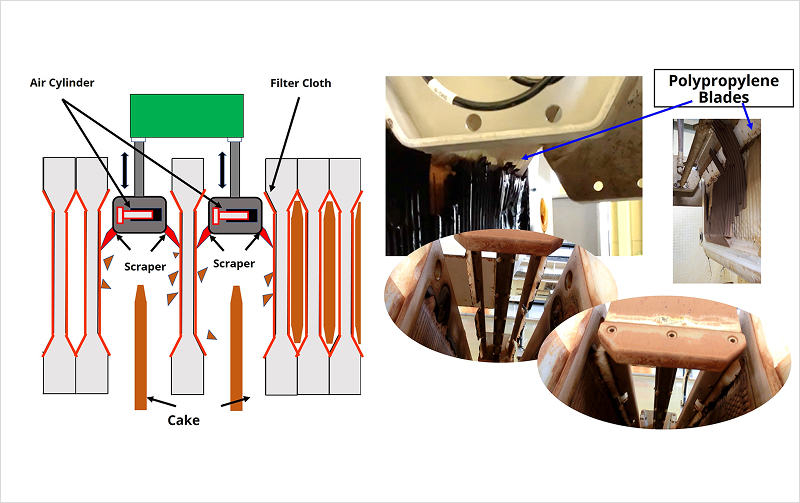
Fig: Scraper Cake Discharge Mechanism – polypropylene blades physically remove cake from filter cloth
9.2 UNEVEN WASHING (CHANNELING): UNIFORM DISTRIBUTION AND CONDITION DESIGN
In cake washing, if preferential flow (channeling) or cake cracking occurs, the wash liquid takes the path of least resistance. This leads to "short-circuiting," resulting in uneven washing and poor efficiency. The solution is a two-pronged approach: (1) optimized distribution design for both slurry feed and wash liquid, and (2) setting operating conditions (pressure, flow rate, and time) that prevent the cake from cracking in the first place.
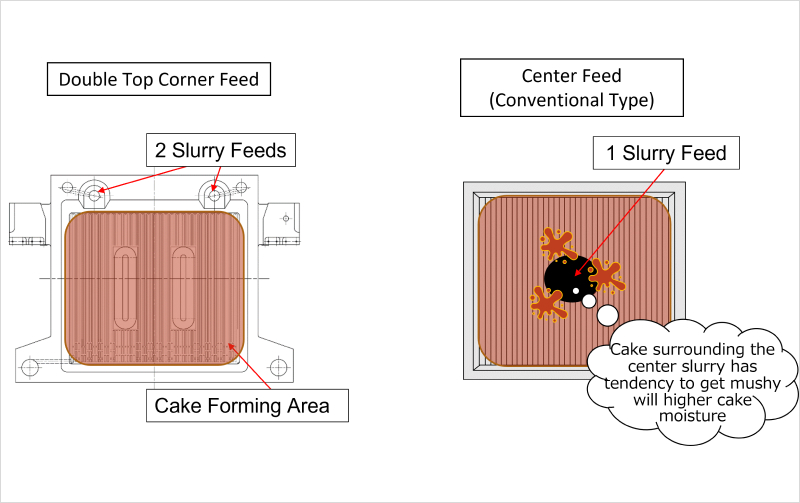
Fig: Double Top Corner Feed (Kanadevia Original) vs. Center Feed – uniform cake formation and washing
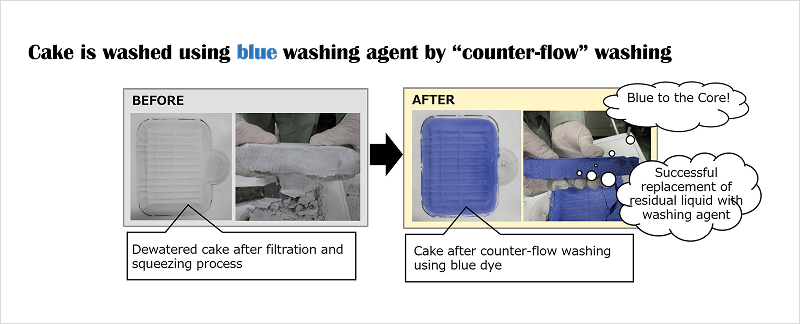
Fig: Counter-flow cake washing result – blue dye confirms thorough, uniform washing
9.3 CORROSION & METAL CONTAMINATION: WETTED MATERIALS AND LEAK PREVENTION
In acidic or chloride-based processes, it’s not just about corrosion—metal leaching can become a serious quality risk. It is vital to align your wetted materials with the slurry characteristics from the start and decide early on if your application is "zero-tolerance" for metallic contamination.
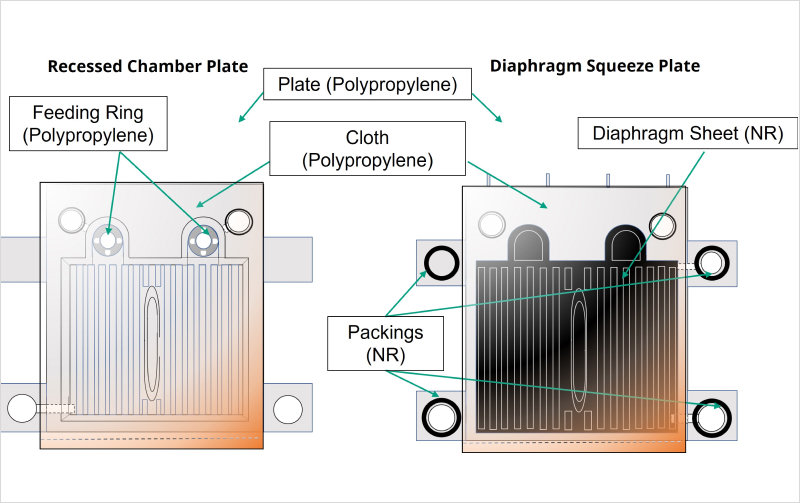
Fig: Metal-free wetted parts – polypropylene plates, feeding ring, and natural rubber diaphragm sheet for corrosive slurries
10. QUOTATION REQUIREMENTS: RFP ESSENTIALS
Once you have shortlisted potential options, the next step is to gather the necessary data for a formal proposal (Quote & Specifications). Providing comprehensive information at this stage ensures a high-accuracy proposal and allows for a faster, more efficient comparative analysis.
10.1 Essential data required for quotation
| Item | Examples / Notes |
|---|---|
| Application & Process | Production (Recovery/Purity) or Wastewater (Disposal Costs) |
| Slurry Characteristics | Solids %, Particle Size, Viscosity, Adhesion, Temperature |
| Corrosive Properties | pH, Chlorides (if known) |
| Target KPIs | Cake Moisture/ Filtrate Quality / Recovery / Washing Requirements |
| Throughput & Operation | Capacity (m3/h), Operating Hours, Cycle Time |
| Site Constraints | Footprint, Power, Wash Water, EHS Requirements |
10.2 WHAT CAN BE VERIFIED THROUGH LAB TESTING?
The most reliable way to confirm filtration rate, cake moisture, filtrate quality, washing efficiency, cake release, and the optimal filter cloth is through a filtration test using your actual slurry. For production-scale applications, these test results serve as the technical foundation for your specifications and provide a clear, data-backed justification for internal stakeholders.
11. NEXT STEPS: MOVING FORWARD WITH KANADEVIA
Simply selecting a filter press type is often not enough to solve on-site operational issues like uneven washing, corrosion, discharge failure, or high maintenance loads. Kanadevia offers specific design features to meet the KPIs critical for production-scale applications:
- Metal-Free Wetted Parts (PP + Rubber): An effective material compatibility option for processes involving corrosive slurries or where metal contamination is a concern.
- Double-Top Corner Feed Structure: Ensures uniform filtration, dewatering, and cake washing, contributing to consistent quality and improved recovery by preventing uneven washing.
- Scraper Mechanism: Assists in discharging sticky cakes, reducing the need for manual intervention and minimizing downtime.
- Top-Draped Cloth Attachment: Simplifies filter cloth replacement, contributing to more predictable and standardized maintenance downtime.
11.1 TECHNICAL CONSULTATION → LAB TESTING → TECHNICAL PROPOSAL
To minimize project backtracking, we recommend following this streamlined workflow: Problem Assessment → On-site or Lab Testing (Customer Witnessing Welcome) → Recommended Specifications based on Test Results (Capacity, Moisture, Filtrate Quality, Washing Efficiency, Cloth Compatibility, and cake release) → Formal Quotation.
- Available Test Units: 350mm Single-Chamber Filter Press × 4 units (Filtration Area: 0.117 m2; Chamber Thickness: 25/30/40mm).
Note: Testing may not be available for certain liquid properties.
11.2 CALL TO ACTION: CONSULTATION / TESTING / QUOTATION / DOWNLOADS
Depending on your current project stage, we offer four primary ways to move your evaluation forward: